


Artist in Residence celebrates ‘place of special value’ in southwest Colorado
Public lands
Place of special value
Protect them for your children
Preserve them for your grandchildren
Practice good stewardship.
The Artist-in-Residence program at Canyons of the Ancients National Monument (CANM), in partnership with the Southwest Colorado Canyons Alliance, hosts artists in a place of “special value.” Featuring the highest density of cultural sites in the country, the Bureau of Land Management (BLM)’s CANM is the ancestral home of 26 tribes and pueblos and protects an estimated 30,000 sites of human habitation.
For two weeks, CANM’s 2026 Artist-in-Residence Vicki Conley worked from dawn until dusk to create four artworks inspired by the monument’s rich landscape and found time to host two public outreach programs.
“I’m a workaholic and I had to bring plenty of projects to keep myself busy,” Conley said. “I got up at 5 a.m. to work on art and sewing in the morning. Because it’s cold, I started to hike around 10 a.m. Then, in the afternoon, more sewing or carving.”
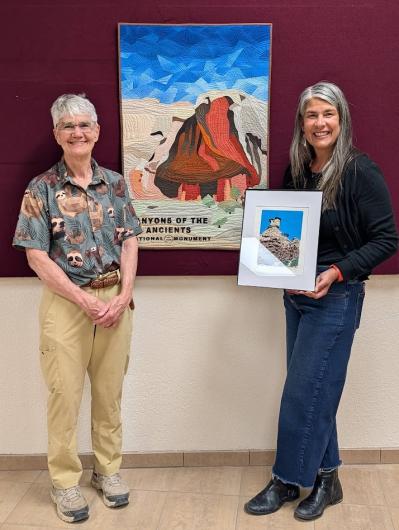
Conley and her husband had visited the monument a year prior and fell in love with the cultural history and natural beauty of the area. Before she set foot back in the monument, she was already hand-dying fabrics to match the landscapes.
“We love this area,” Conley said. “I’m a desert person, so I love all desert parks. But the view before you drop down into the Sand Canyon — it is just spectacular.”
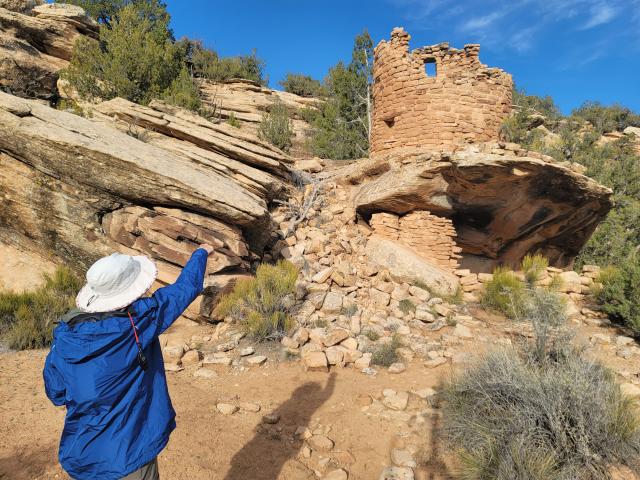
BLM staff personally guided the Artist-in-Residence through Sand Canyon, Lowry, and Painted Hand pueblos, to the heart of the monument, and around the 88-mile backcountry route. Conley was also able to experience Sand Canyon several days on her own while sketching and preparing linoleum blocks for printing.
“We find a lot of value in hosting artists at Canyons of the Ancients National Monument and being able to spend good quality time with them on the landscape. It's important to show them just how special these places are,” said Amala Posey-Monk, supervisory park ranger for CANM. “It takes time and an open heart to learn about the complexities, history, and cultural sensitivities of the 26 tribes and pueblos who have called this landscape home since time immemorial. We’ve set up this residency so artists get to spend time with our subject matter experts in the field or in curation to find that deeper connection."
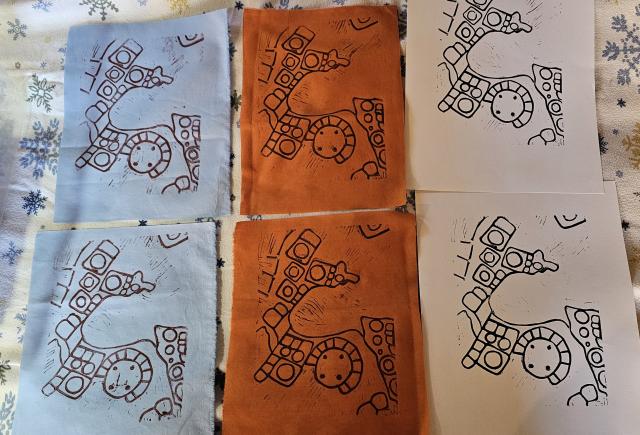
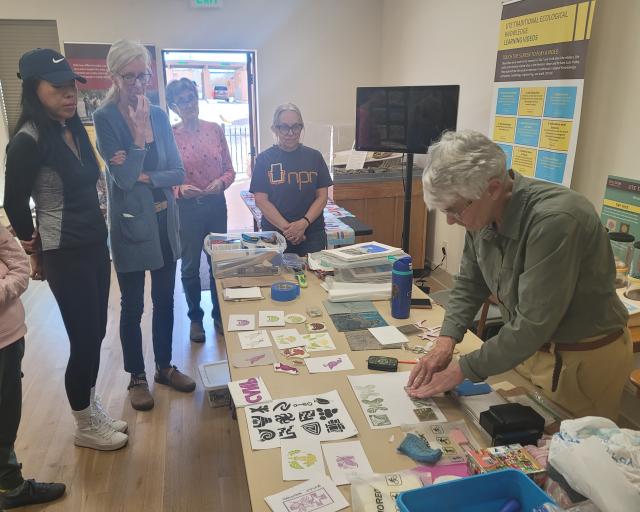
CANM’s 2026 Artist-in-Residence program came to a close with two public workshop events. Conley provided a short lesson on simplified block printing, then set visitors loose to carve and print their natural designs inspired by the monument and its ancestral residents.
“It’s been such an opportunity [to be at CANM],” said Conley. “I really appreciate the Southwest Colorado Canyons Alliance for their support and [the BLM] for the beautiful landscape and guidance. It’s been great.”
Encompassing 176,000 acres of public lands, CANM features more than 8,400 documented sites of human history, including villages, kivas, field houses, cliff dwellings, petroglyphs, and ancient roadways. Some areas have more than 100 sites per square mile.
Today, CANM’s special landscapes continue to serve visitors, artists, and locals alike as a space for inspired recreation, hunting, livestock grazing, and energy development.
Related Content
Related Stories
- Fossils, furs and a few sparks at Kemmerer Outdoor Discovery Day
- Celebrating National Public Lands Day across the High Desert District in Wyoming
- One Mile Closer
- BLM recruits future workforce at Missouri University of Science and Technology career fair
- Pipestone Roars to Life as Community Comes Together for National Public Lands Day