


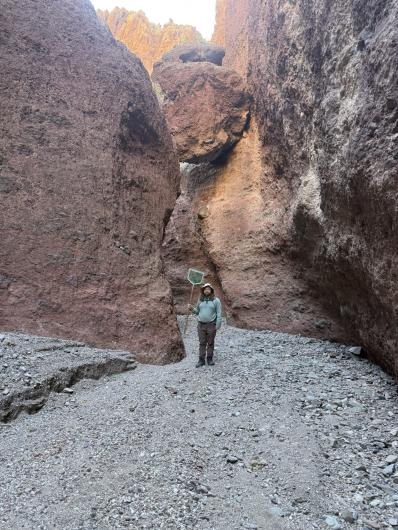
Meet Dashiell Gould Lagoyda, fisheries biologist intern at the Safford Field Office
The Bureau of Land Management (BLM)'s internship programs offer people the opportunity to explore public service, develop hands‑on skills, and contribute meaningfully to the stewardship of America’s most diverse landscapes.
And on National Service and Conservation Corps Day, which is on June 12, the BLM proudly recognizes interns and young people across the country whose passion and service strengthen the future of public lands. Since the days of the Great Depression, conservation corps programs have empowered Americans to improve public lands, gain valuable skills to enter the job market, and support the resilience of their local communities. Today, BLM continues this tradition by employing Conservation Corps crews and interns ages 16 to 30 (35 for veterans) to assist in a wide variety of conservation, restoration, and preservation projects on public lands.
One of those interns is Dashiell Gould Lagoyda, who interned with the Safford Field Office. His work, funded through the Bureau of Reclamation’s Gila River Basin Native Fishes Conservation Program, has taken him deep into Arizona’s desert waterways. This critical initiative fulfills federal environmental mandates to protect the many endangered desert fish from invasive species introduced by the sprawling Central Arizona Project (CAP) water delivery system. From removing invasive species in Bonita Creek to learning the rhythms of fieldwork in a rugged, time‑sensitive environment, Dashiell has embraced every challenge with curiosity, adaptability, and dedication.
“Dashiell has been a great addition to our team this season. His willingness to learn, positive attitude, and genuine care for the work we do have made a real impact on our projects,” said Heidi Blasius, BLM fisheries biologist and Dashiell’s internship supervisor. “He has approached every opportunity with curiosity and dedication, and it’s been a pleasure to watch him grow throughout the season. I’m excited to see where his passions and interests take him next.”
His experience reflects not only the breadth of BLM’s mission but also the impact that engaged young people can have on the health and future of public lands. As BLM marks 80 years of stewardship and the nation celebrates 250 years of history, stories like Dashiell’s remind us why it matters for this generation to get involved: America’s public lands depend on those willing to step forward, learn, and lead.
If you’re eager to dive into hands‑on fieldwork, expand your skills, and help shape the future of America’s public lands, a BLM internship is an exciting opportunity you won’t want to miss.
Read on to learn more about Dashiell’s internship experience with the BLM and how to get involved.
Can you tell us a bit about yourself and what inspired you to apply for this internship with the BLM?
After earning my undergraduate degree in biology and environmental studies, I decided to explore a variety of jobs in different fields of related studies, locations, and with different groups of organisms, to better understand what I would like to focus on in graduate school.
Working with BLM especially interested me because my prior field experience primarily focused on working with terrestrial organisms in corporate or university settings. The BLM internship felt like a great opportunity to experience working within a government agency while also expanding my skill set in handling aquatic organisms.
What are some of the key projects or tasks you’ve been working on during your internship?
While interning in Safford, my main task has been removing invasive fish, particularly yellow bullhead catfish, from Bonita Creek. This is done to make the creek more hospitable for local and native fish species. Without this work, yellow bullhead catfish could easily outcompete other species in the creek, dramatically decreasing biodiversity and the river's health, and causing the loss of unique fish species found only in Arizona's rivers.
What has been the most rewarding aspect of your internship experience so far?
There have been two especially rewarding aspects of my internship.
The first is being outdoors regularly in such a unique environment, i.e., rivers and creeks in a desert ecosystem. It has been especially enjoyable as someone who grew up in the mid- and northeast coast area. Being here has really broadened my horizons and made me interested in learning about other organisms living in environments I might consider atypical.
The second rewarding aspect has been the opportunity to improve my animal-handling skills, expanding my pre-existing abilities to handle small mammals, fish (some of which are venomous), and other aquatic organisms. Not only does being able to transition from handling small mammals to fish prove to others that I can be adaptable to working successfully with a wide variety of organisms, but it’s also a confidence boost. This experience leaves me confident that I am capable of succeeding in future transitions and challenges I may face in my career or in life as a whole.
How has this internship contributed to your personal and professional growth?
This internship has expanded my skill set to include trapping and working with aquatic organisms. The field-based opportunity demonstrated how important communication is in such work, particularly in a time-sensitive environment and position (be it how much time we have in the day or making sure the animals aren't in the traps for too long).
Before this opportunity, I primarily worked in a setting with a clear, leveled hierarchy. The BLM Arizona team is also a much smaller team compared to those I have worked on previously. At BLM, my coworkers and I were at similar organizational levels, underscoring the importance of communication, clarity, and cooperation when working with sensitive organisms within a limited time frame.
What have you learned about the BLM's mission and goals during your time here?
When I joined the BLM, most coworkers to be field technicians interested in conservation and the environment, or firefighters and rangers protecting and maintaining the area for public use. After working here and getting to know people, I’ve learned that their backgrounds and specialties are much broader. For example, some focus on determining the best locations and materials for construction projects, while others create maps tailored to the needs of different partners or institutions.
What skills or knowledge have you gained from this internship that you plan to use in your future career?
I have seen how valuable being proactive and accessible can be in helping coworkers, and that sometimes it means doing a little extra work. Be it something as simple as staying a little longer at the office to clean the work vehicle or reaching out to someone who works in a similar field for ideas and feedback.
I have also learned how important it is to ensure your communication is clear and received when working with others in fragile, time-sensitive areas.
What are your goals after your internship with BLM?
My current goals are to apply to graduate school to earn a master's degree, followed by a PhD. While I’m still not sure about the subject and area I will focus on, I know that I want to conduct scientific research on animals and hope it can be applied to conservation. The position with BLM has helped to solidify this desire.
What advice would you give to someone considering an internship with the BLM or in a similar field?
My advice may sound basic, but sometimes, because it is basic, it can be both important and overlooked.
The first is to make sure you have extra of what you need and that it is properly prepared in advance. If you get sunburned easily, like me, keep two sunscreens in your backpack and two at home. If you don’t have much time at home to make meals for the next workday, meal prepping can be extremely helpful. Being overprepared, rather than needing something you do not have, is always preferable.
Next, communication is key. What I have found is the best way for me to remember what others say is to repeat it back to them. It is helpful to have colleagues reciprocate this as well.
Lastly, and this is the most important, you need to have confidence in yourself in the work you are doing, so you can do a good job. You also need to ask questions and seek feedback to improve your performance.
Public lands have played a vital role in America’s story for 250 years. How has your internship helped you appreciate that history?
Working here, in a dramatically different ecosystem from where I grew up, has really made me realize how varied the U.S.'s lands and environments are, and how the ecosystem of an area can impact its culture.
As we celebrate 250 years of American history and 80 years of BLM’s stewardship, what does it mean to you to be part of this legacy of caring for public lands?
I am proud to be part of a long line, both historically and, hopefully, in the future, of diverse individuals united in caring for public lands.
What would you say to other young people about why it’s important to get involved in public lands stewardship?
If you care about public land whether for recreational purposes or for its own sake, then not only is it a good idea to work in a public lands stewardship to learn more about how it operates, likely gaining a deeper connection to it, but it will only continue to be accessible and healthy if people that care about public land step up and help take care of it.
If you’re looking to build real-world skills, explore new environments, and make a meaningful impact on America’s public lands, consider applying for a BLM internship — you never know where the experience might lead. For more information about internships at the BLM, visit the Internship Program webpage or the Corps Network for national corps crew and internship opportunities near you.
Have a question about internships at the BLM in Arizona? Email Brooke Wheeler, State Youth, Volunteer and Environmental Education Lead, at bwheeler@blm.gov.
Related Stories
- National Public Lands Day Paddles, Plants and Caves: BLM Connects Milwaukee Youth with the Outdoors
- National Public Lands Day Volunteers Revitalize Dean S. Reservoir in Montana
- Celebrating 30 Years of California Condor Recovery at Vermilion Cliffs National Monument
- Using Beavers as Partners in Riparian Habitat Restoration in Las Cienegas National Conservation Area
- BLM recruits future workforce at Missouri University of Science and Technology career fair
Office
711 S. 14th Avenue
Suite 100
Safford, AZ 85546
United States