


BLM Colorado water rights specialist wins Riparian Hero Award
When Roy Smith joined the Bureau of Land Management (BLM) in 1992 as a water rights specialist, he immediately dipped his toe into working with the State of Colorado to ensure water resources were available for public lands and wildlife.
“In the water world, the federal government is in a unique position because Congress delegated water allocation to state governments,” Smith said. “I noticed that challenge and saw an opportunity. I thought BLM could become a great partner to the state government in the water rights arena, where there’s often state-federal conflict.”
Smith had studied water and hydrology work in graduate school, and when applying for jobs, he knew he wanted to work in a position related to water rights. He found four jobs after graduating that fit the bill. Three of those positions were in the private sector, but he was the most motivated to get the position with the BLM.
He soon realized many programs within the BLM focus on arid landscapes and are dependent on water, from grazing and wildlife to aquatics and timber management. The BLM shares water resources with other users but did not have authority to ensure adequate water supply to support what the landscape required for successful multiple use management.
Smith learned that the State of Colorado had a program for the purpose of keeping water available for land management.
“I thought maybe BLM can help expand the state’s program, which could help us facilitate flows for multiple uses and to protect important resources,” Smith recalled. “Most flows for wildlife back in 1992 were for higher altitude streams where cold-water fisheries are located, so my first idea was to consider warm water fish habitat at lower altitude. My love of collecting field data drives my work, so I assembled a team to work on Mesa Creek.”
This thought landed with a splash. Smith worked with BLM staff to develop recommendations for the Colorado Water Conservation Board, which would help the BLM manage habitat on multiple streams across the Uncompahgre plateau for rare, warm water fish.
That initial effort went swimmingly, and Smith’s work in water management grew to encompass work on BLM lands across the state, enabling more strategic land use planning for managers. He established projects for not only fish habitat, but to benefit riparian ecosystems. He started with an area globally known for its rare riparian communities – the San Miguel River – in southwest Colorado.
“After flows were secured on the San Miguel River, I recommend projects on streams where the riparian habitat is the main driver,” Smith recalled. “And the opportunity was kind of dumped in our lap.”
The Dominguez-Escalante National Conservation Area was designated in 2009 through the Omnibus Public Land Management Act. Smith used the opportunity to inventory flows and found that the uppermost areas along the Big Dominguez Creek and the Little Dominguez Creek had fish, but lower areas did not.
He used a methodology from the Army Corps of Engineers that calculates flow rates for events when floods occur and researched how Cottonwood-dominated streams need floods for seeds to germinate and build roots. Based on that information, he was able to recommend changes to flow rate and water variability of the creeks. In those creeks, flooding would create open space for Cottonwood seeds to germinate and ensure that groundwater receded slowly so that seedlings could build roots to chase the limited water supply. The flooding also helps bury flammable forest floor debris with sediment, reducing hazardous fuels for fires.
“That effort to protect flows was consistent with the BLM multiple use mission,” he noted. “With the proposal, we also worked with the state to ensure that some of that water would be available to upstream private landowners to use for their property in the future.”
He had hooked a big one with that approach, further enhancing resources available on the landscape for multiple use decision-making while protecting fish and wildlife. The BLM and the CWCB collaborated to expand the model of focusing on flood flows to three other creeks on the Uncompahgre Plateau.
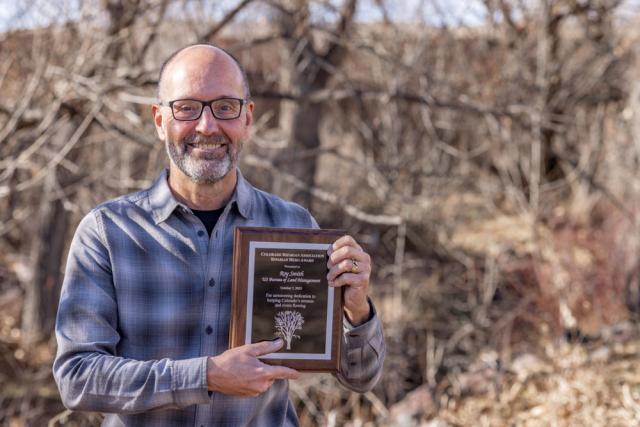
Smith’s body of water work was recognized this year by the Colorado Riparian Association with the 2025 “Riparian Hero Award.” This is given to recipients for their “unwavering dedication to keeping Colorado’s streams and rivers flowing.”
“What was so special to me about the award is that it recognized that flow protection projects require persistence over an entire career,” he said. “The Association’s members really value persistence because they work on slowly rehabilitating watersheds, project by project.”
This is but one of many awards Smith has received due to his work with a broad array of stakeholders and interdisciplinary organizations throughout his career. He received the Public Lands Foundation’s Outstanding Public Land Professional Award in the Operations/Technical category, the Career Contribution to River Management Award from the River Management Society, and the Olaus and Margaret Murie Award for Risk and Innovation from The Wilderness Society for his work advancing the collaborative management of river systems.
And Smith’s work isn’t done. He is serving as the BLM’s liaison to the Deep Creek stakeholder group, lending his expertise to help make sound water management decisions in the future.
“The water rights world works slowly, so doing this kind of work literally takes a whole career dedicated to this kind of work to move the ball forward,” said Smith, who is now titled as BLM Colorado’s expert in Water Rights, Instream Flow Protection, and Wild and Scenic Rivers. “When flow protection finally happens, I’m ecstatic. I enjoy working on projects that develop innovative water management approaches in the water rights world. I am finally getting those projects across the finish line.”
Related Stories
- Celebrating 30 Years of California Condor Recovery at Vermilion Cliffs National Monument
- K2-Play Completes Final Phase of North Fruita Desert Trails Master Plan
- Using Beavers as Partners in Riparian Habitat Restoration in Las Cienegas National Conservation Area
- One Mile Closer
- Fossils, furs and a few sparks at Kemmerer Outdoor Discovery Day
Office
PO Box 151029
Denver Federal Center - Building 40
Lakewood, CO 80225
United States