


Firefighters and Archaeologists Collaborate to Protect Historic Mining Site during Monroe Canyon Fire
MONROE, Utah — In early August 2025, a coordinated effort between resource advisors, archaeologists, and wildfire personnel with the BLM, USDA Forest Service, and the now established U.S. Wildland Fire Service sought to protect a historic mining site on Miner’s Ridge from the advancing Monroe Canyon wildfire.
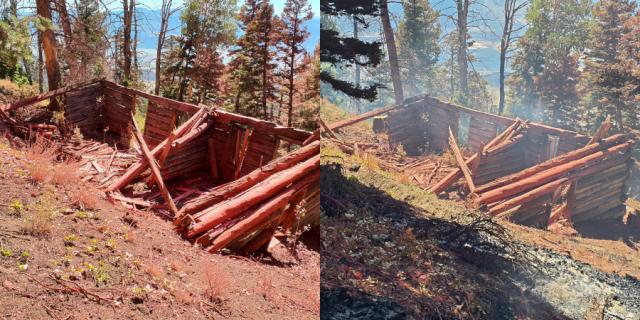
The site, dating back to the 1920s, included a collection of wooden structures and mining remnants: three log cabins, a barn-like building, an outhouse, ore stockpiles, two historic debris scatters, and a mining shaft. These features were connected by a network of trails and wagon roads, offering a rare glimpse into Utah’s early mining history.
Protecting such vulnerable heritage is why archaeologists are frequently called to active wildfires. Serving as specialized resource advisors, these professionals work directly with Incident Command to identify and map irreplaceable cultural resources before they are lost. Because wildfire operations move rapidly, their early intervention provides Incident Command with the real-time data needed to integrate historic preservation directly into tactical fire suppression strategies, ensuring that centuries-old structures are not lost by wildfire or inadvertently damaged by heavy equipment or standard suppression efforts.
Upon notification from archaeologists , the Incident Commander for the Monroe Canyon Fire ordered protective retardant drops near the structures. As the fire continued to creep forward, helicopters and planes delivered repeated water drops in an effort to shield the site.
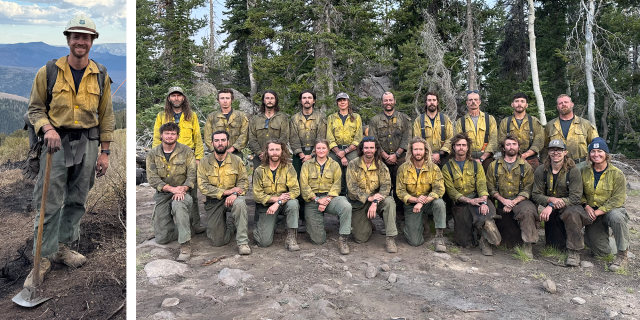
Despite these efforts, the wildfire was ultimately too strong and four of the five historic structures were destroyed. The lone structure standing was saved due to the quick thinking and hard work of the Cedar City Hotshots, particularly a man named Almanzo Wenig.
While the majority of the Cedar City Hotshots were committed to suppression work on a lower part of the mountain, Wenig, Hotshot captain, was flown up the mountain to get eyes on threats ahead. Seeing the risk to the historic mining site, Wenig began burning out fuels in the area to create a buffer. Working largely alone at first, he directed aerial water drops and used hand tools to clear vegetation around the most vulnerable structure, a miner’s cabin, establishing a defensible space as the fire advanced. After finishing critical work downslope, the rest of the Hotshots were able to make their way to Wenig. The crew dug additional control lines around the remaining miner’s cabin and continued reinforcing its protection. Over the following days, the Hotshots repeatedly hiked back to check on the cabin, maintaining firelines and ensuring it remained secure.
“Fighting the fire was our top priority, but when we saw that we could save the cabin, we felt that we should save the cabin.” Wenig said of the Cedar City Hotshots determination to protect the archaeological site.
“The efforts of the firefighting crews are deeply appreciated,” said Lori Hunsaker, State Archaeologist for BLM Utah. “This site represents an important chapter in our state’s heritage, and we are grateful for the dedication shown to protect it.”
This incident highlights how important integrating cultural resource protection into wildfire response operations truly is. The collaboration between archaeologists and fire personnel serves as a model for future efforts to preserve irreplaceable historical resources in the face of natural disasters.
Related Stories
- National Public Lands Day Paddles, Plants and Caves: BLM Connects Milwaukee Youth with the Outdoors
- Using Beavers as Partners in Riparian Habitat Restoration in Las Cienegas National Conservation Area
- Celebrating 30 Years of California Condor Recovery at Vermilion Cliffs National Monument
- Fossils, furs and a few sparks at Kemmerer Outdoor Discovery Day
- Nails and Tires Don’t Mix