


Local Paleoartist Captures BLM Dinosaur Death Struggle
MILES CITY, Mont. — African lions, leopards, and hyenas know this. Apparently, a T. rex knew it too: “Control the head and you can control the body.”
Well, theoretically.
It makes sense to keep one’s surprised and frantic prey at "arm's length" (a phrase that wouldn't make much literal sense to a T. rex)—at least far enough away to avoid the kicking, biting, and clawing that follows, and to keep the “menu item” from getting away.
Meet "MOR 1627"—an entire Edmontosaurus head on display at the Museum of the Rockies (MOR). MOR 1627’s crown jewel is a snapped T. rex tooth stuck in the bridge of its snout. The fossilized head is about a yard long. The tooth is a tiny, shiny, root beer-colored bit that peeks out a few inches down the snoot from the gaping eye socket. It glimmers, serrated like a miniature saw blade.
Paleoart is the bridge between dusty bones and living history. When researchers Taia Wyenberg-Henzler and Dr. John Scannella published their groundbreaking study on the MOR 1627 skull, they turned to Jenn Hall of Miles City to illustrate the terrifying encounter.
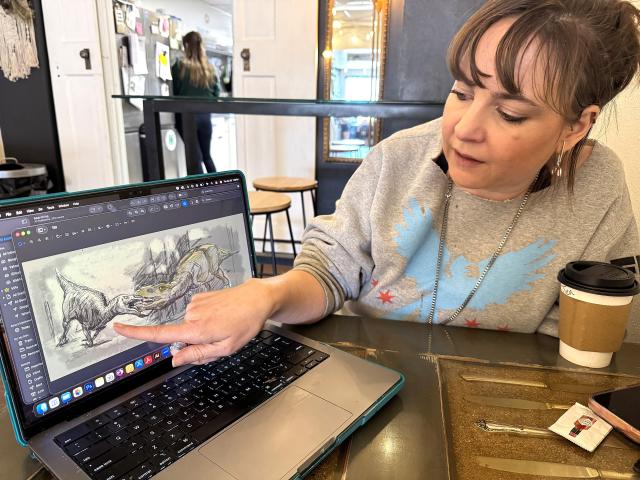
"We really needed to capture the moment of 'the bite,'" said Hall. "It’s an unfortunate 60 seconds when you (as the Edmontosaur) are caught up in grazing and let your guard down. All of a sudden, your predator takes advantage of that moment."
Hall’s style is a fusion of experience gained at the University of Pennsylvania, years of working with paleontologists combined with classical art training at the Pennsylvania Academy of the Fine Arts. Sprinkle that with a dose of up-close anatomical observations from a taxidermy sideline, attention to "what-if" details, and a reconstruction of prime prehistoric ambush conditions, and you have a vivid rendition of the final moments of MOR 1627.
Hall described her thought process designing a dynamic action scene—the twisting, wrenching fight between the hunter and the hunted. Big-bodied, heavy flesh-and-bone titans grappling for keeps.
For both modern and prehistoric predators relying on tooth and claw, this isn’t just about dispatching dinner; it’s about avoiding broken bones, dislocations, or a disemboweling kick. Incapacitation means vulnerability and starvation. Don’t forget that a T. rex was—or might have been—on someone else’s menu, too.
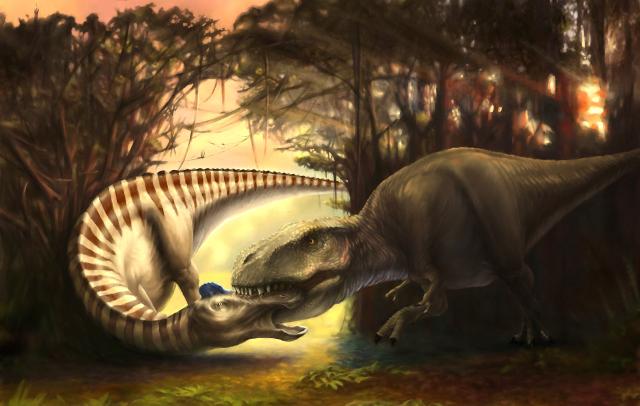
Hall’s painting frames the confrontation exactly as the crime-scene evidence indicated: "face-to-face." In the artwork, you don't see a T. rex biting a leg or ripping at a flank. Instead, you see the predator locking its massive, bone-crushing jaws directly over the Edmontosaurus’s snout. One can almost sense the bone-cracking force required to drive a massive tooth into that leathery, scaly, duck-bill muzzle—and snap it off clean.
Scientists continue to debate whether T. rex was a majestic top predator or a six-ton flightless vulture roaming what is now the Hell Creek Formation looking for free leftovers. MOR 1627 provides some of the strongest evidence yet for the "predator" column by highlighting a hunting technique used by modern carnivores.
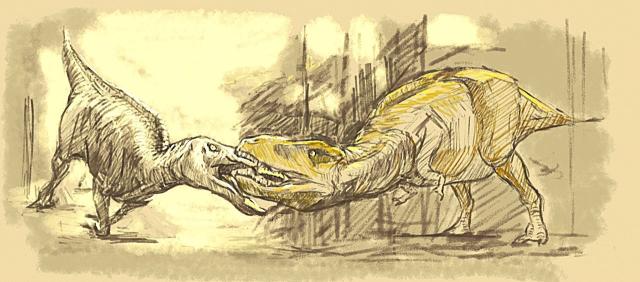
Hall shared a few concept sketches she drew for MOR staff to consider. The T. rex twists in some; it bears down in others. Yet for the Edmontosaurus, the end never changes. Hall described the exchange of ideas with MOR staff regarding possible postures, poses, and body orientations—"the subtle and gestural things," she called them, like the "grab and the twist."
"In paleoart, you’re caught between capturing the artistry and communicating the science," she said, likening the collaboration to "a friendly game of catch where you throw things back and forth."
When MOR picked their finalist, it was entitled “The Bite." Judging from the artwork produced throughout the project, it must have been difficult to choose only one. Any piece would have been an excellent choice.
MOR 1627 and its T. rex tooth were excavated from BLM public lands in eastern Montana under the Miles City Field Office. The Hell Creek Formation kept this specimen a secret until paleontologists uncovered it in 2005—yet another example of how fossils excavated from your lands continue to inform the greater scientific community worldwide.
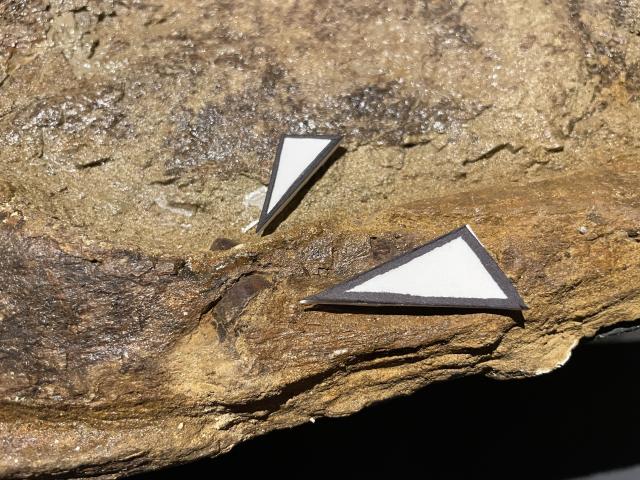
The actual skull, complete with the tooth, is on display at the MOR "Hall of Horns and Teeth." You can’t miss it; the case sits low enough to give you a very close look. A complementary resin cast of the skull, supplied by MOR, is also on display at the BLM Montana/Dakotas State Office in Billings.
Under the authority of the Paleontological Resources Preservation Act, the U.S. Department of the Interior oversees a coordinated, science-driven paleontology program across federal lands managed by the BLM, National Park Service, Bureau of Reclamation, and U.S. Fish and Wildlife Service.
This program safeguards and curates America's rich fossil heritage by balancing public education initiatives, like the Junior Paleontologist program, with a strict permitting process for scientific research. Through this federal framework, authorized institutions—including the Museum of the Rockies at Montana State University—are able to legally excavate these public treasures, transforming raw scientific discoveries into shared global knowledge.
Related Stories
- National Public Lands Day Volunteers Revitalize Dean S. Reservoir in Montana
- Fossils, furs and a few sparks at Kemmerer Outdoor Discovery Day
- Nails and Tires Don’t Mix
- Pipestone Roars to Life as Community Comes Together for National Public Lands Day
- Healing Hooves: How a Once‑Wild Burro is Bringing Joy Across Pennsylvania and Competing Nationally