


Let’s talk about Mustang Camp
If you’ve ever wondered how young people can learn about wild horses and public land management in a meaningful way, Mustang Camp is a good place to start. In partnership with the Bureau of Land Management, Utah State University Extension’s 4-H “Mustang Camp: Healthy Lands and Healthy Horses” has been helping youth explore what it really means to care for shared landscapes in the American West since 2021.
As the BLM embarks on a year-long celebration of our nation’s 250th Anniversary, we’re highlighting the enduring values of Freedom and Liberty—principles symbolized by the wild horses and burros roaming the West. Programs like Mustang Camp reflect those ideals and empower young people to enjoy, explore, and learn about how the BLM stewards our public lands and wild horses and burros.
Mustang Camp
Last summer, Mustang Camps in California, Nevada, and Utah brought together youth from across the West for unforgettable hands-on experiences. The California camp began with icebreakers and laughter at the Alturas fairgrounds, leading into practical classroom lessons for the curious kids. There were presentations, questions, stories, and hands-on activities with games and models that brought to life rangeland health, population management, and the challenges of managing wild horses on public lands. With all that discovery, strangers quickly became teammates.
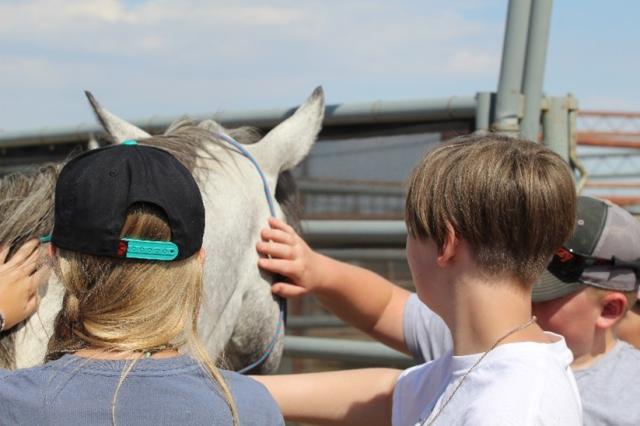
An important aspect of Mustang Camp is real-world experiences. At the California camp, students were brought to the Litchfield BLM Wild Horse and Burro Off-Range Corrals to observe the animals and feel the soft thud of hooves on packed ground and hear the quiet sounds of horses shifting and breathing nearby. With the facility manager and wranglers on hand to answer questions — Where did this one come from? … How old is she? — the excitement was impossible to miss. Seeing wild horses up close makes the idea of land management real, personal, and unforgettable.
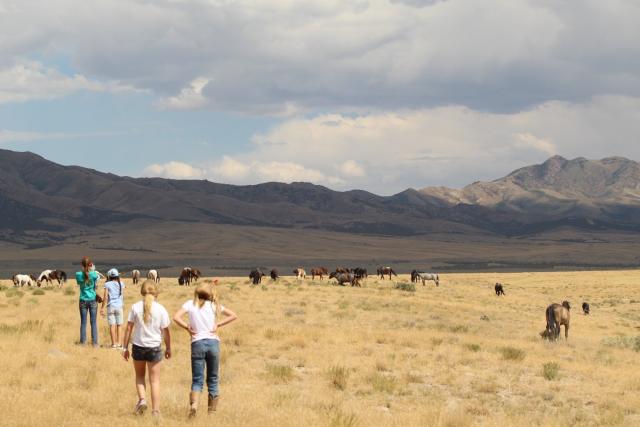
Campers then headed out onto windy BLM-managed sagebrush in the Twin Peaks Herd Management Area. At first, the hills looked empty until someone whispered, “There—over there...” Through binoculars, in the distance, wild horses appeared as small moving shapes, their coats catching the light as they grazed together. Near them, wild burros moved slowly through the brush, ears tall and alert. The kids buzzed with excitement, gasping, pointing, double-checking sightings, amazed that something so wild can exist just beyond the horizon.
Into the evening a small fire crackled under roasting hot dogs. Kids sat on rocks and tailgates, trading stories and laughs as the sun was setting. Before bed at the fairgrounds, they spread blankets and watched a movie flickering to life under the wide California sky.
After all the fun on the range, kids grappled with hard questions on the last day of camp. They come up with and talk through ideas that could help keep wild horses and public lands healthy and thriving. This is when campers consider rangeland ecology through the lens of their own hands-on experience. The lessons learned at Mustang Camp are tied to the memories and experiences that were created – lessons these youth won’t soon forget.
After a successful 2025 Mustang Camp and as we head into 2026, Jessie Hadfield, Utah State University’s 4-H Agriculture and Animal Science Specialist and the lead on the Mustang Camp program, shared her thoughts on how the program has been going:
What is Mustang Camp?
JH: The Mustang Camp’s mission is to help youth understand what it takes to care for healthy lands and healthy horses and, most importantly, to help young people see themselves as part of that story.
At its core, Mustang Camp is about connection — between youth, land, horses, and the people who manage public resources.
Participants go out, learn how rangelands function, and explore how wild horses, wildlife, livestock, and people all depend on the same ecosystems. The goal isn’t to tell youth what to think, but to give them tools to think critically and to understand why deliberate management rooted in science matters.
How did Mustang Camp get started?
JH: Mustang Camp began in 2021 as a pilot program through Utah State University Extension, with in-kind support from the BLM. Those early camps brought together youth from across Utah to learn about rangeland health, wild horse biology, and public land policy through hands-on experiences. Giving young people the chance to see land management up close really changed how they understood the issue. We couldn’t have done it without the incredible support and involvement from Utah’s BLM Wild Horse and Burro personnel that gave us behind-the-scenes access and insight. The success of those first camps created momentum that continues to drive the program today.
In 2023, the BLM awarded a cooperative agreement to Utah State University to expand Mustang Camp in a way that can benefit youth groups from across the country. With BLM support we’ve developed online curricula specific to 4-H clubs, and made hands-on kits and online lesson plans available to any group that asks. In the next year we’ll be increasing the number of videos that bring kids from far and wide right out with us into the landscapes where these horses and burros live.
Who participates in Mustang Camp?
JH: Mustang Camp is open to all youth ages 8–18. Each camp is intentionally designed to engage a wide range of ages, and we regularly welcome both first-time and returning participants.
Many campers return year after year, including Alli and Harley, active members of the Utah 4-H Horse Program who have both served in county and state 4-H leadership roles. They both heard about Mustang Camp through their local 4-H leaders, and signed up to attend because they loved their equine projects and had strong opinions about wild horses. Alli described the experience as “life changing,” noting that after her first camp she and her sister became involved in the wild horse and burro training programs and participated in challenges, ultimately adopting two mustangs. Harley attended camps in both Utah and California and shared that Mustang Camp broadened her perspective, giving her a well-rounded understanding of both the history and future of wild horses and burros.
While Mustang Camp often attracts youth involved in horse and livestock projects, we make a deliberate effort to include youth from suburban communities who may not realize wild horses and burros live on the public lands near them. These participants often experience the greatest transformation.
One memorable example is Benjamin, who joined one of our earliest camps as a self-described science enthusiast looking for an outdoor experience. He had never worked with horses or spent time on public lands. His Mustang Camp experience sparked a lasting interest in science and land stewardship, leading him to become a Utah 4-H State Agri-Science Ambassador and pursue a career path in natural resource management.
Why focus on wild horses and public lands together?
JH: You really can’t talk about one without the other. We really try to express that wild horses are powerful symbols of the West, but they live on public lands with scarce resources. Our public lands must support many different uses from recreation to livestock production, and many different species call our rangelands home. Mustang Camp helps kids explore that reality — how land health affects horse populations, and how management decisions aim to balance populations with available resources.
Who makes Mustang Camp possible?
JH: Mustang Camp is a collaborative effort. Our “Mustang Gang” team includes myself, our program coordinator Kim Dorsey, and USU Extension faculty Steven Price, Kalen Taylor, Nicki Frey, and UC Davis Extension Faculty Laura Snell with special support from Linden Greenhalgh, Mark Nelson, and Dr. Eric Thacker. We also have the funding and staff support provided through the Bureau of Land Management. Of course we’d be remiss not to mention the in-kind contributions from other land management professionals, educators, and subject matter experts all playing a role in delivering accurate, relevant, and engaging learning experiences.
How many youth have attended in-person Mustang Camps?
JH: Since 2021, over 110 youth have come to overnight Mustang Camps. We plan to add at least two additional in-person camps in 2026 as well as increasing access to our virtual materials and downloadable lesson plans. Our before-and-after surveys show that participants gain a deeper understanding of, and appreciation for, land management and the complexities of managing wild horses and burros on public lands so we are striving to reach as many youth as possible!
When is the next Mustang Camp and how can I sign up?
JH: Registration for the majority of in-person 2026 Camps is already open on our USU Extension office website. So save the dates and plan to join whichever is closest to you!
Idaho, Marsing – June 16th & 17th, 2026
Utah, Tooele/Delta – June 25th & 27th, 2026
California, Susanville/Litchfield – August 6th – 8th, 2026
Additionally we are in the final stages of bringing camp back to Elko/Reno Nevada and introducing camp to the Grand Junction and Denver Colorado areas. Dates Coming Soon!
You can find registration and find more information here: https://extension.usu.edu/utah4h/events/mustang-camp
You don’t have to live in the Western U.S. to join us. Youth who can’t come to in-person camps can register to attend our virtual camp being hosted later this year.
What other resources are available?
JH: As part of our desire to reach as many youth as possible, all of our resources are available for FREE download off our website. Parents, teachers, and youth group leaders are able to access digital downloads of all our lesson plans and camp guides, or purchase our Mustang Camp Kit that has all the supplemental workshop materials and printables to host their own hands-on camp.
These resources allow Mustang Camp concepts to be adapted for local groups’ needs while maintaining a science-based foundation.
Please check out our resources to learn more at the Mustang Camp website: https://extension.usu.edu/utah4h/events/mustang-camp
Thank you Jessie – Good luck to your team and we wish the best to all of the 2026 Mustang Camp participants!
Related Content
Related Stories
- BLM Showcases Local Recreation Treasures Ahead of National Hunting and Fishing Day
- Healing Hooves: How a Once‑Wild Burro is Bringing Joy Across Pennsylvania and Competing Nationally
- Gallant: A BLM mustang with a bright future
- Bringing Wild Horses and Burros Home: Doswell’s Adoption Event Inspires Community
- Meet the inmate-trained wild burros available in Arizona on August 14