


Volunteer sees cycle of stewardship through her work on historic cave
Cavers are a special breed. They like exploring tight dark places, undeterred by mud and whatever may be lurking.
Give a caver a task to do, while down in a cave’s depths, and they will stay underground for hours and come back again a few weeks later to do it again.
As it turns out, these are the same unique qualities found in some of the Bureau of Land Management’s most remarkable volunteers. The Bureau recently recognized one, in particular, with this year’s BLM Outstanding Volunteer Achievement Award.
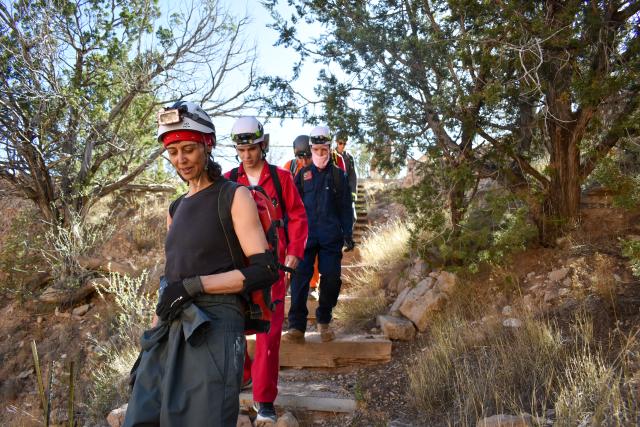
Carrin Rich from Carnuel, New Mexico, led cave restoration work at the Fort Stanton-Snowy River Cave National Conservation Area, along with a team of more than two-dozen volunteer cavers from New Mexico and Texas. The cavers were from local chapters of the National Speleological Society and included a handful of high school students, as well.
“There is a ready supply of prepared and willing active cavers in New Mexico and West Texas,” Rich said. “Cavers love getting their hands dirty and doing work.”
The work is physically and mentally demanding. Not everyone can spend that amount of time underground. Often, Rich will lead a team of four to five cavers for 12- to 15-hour expeditions. The team will stay overnight on the surface before and after the expedition to prep the gear and later to clean the gear.
“The work consists of washing cave formations – stalactites, stalagmites, and walls of flow stone,” she said. “We’re literally washing the cave with sprayers, washers, and sponges.”
The team is removing muddy boot prints, handprints, and marks from packs brushing against the walls during years of people roaming the caves. The marks, debris, and mud left behind don’t just change the appearance of the cave but can also alter the environment for species that depend on that environment.
The Fort Stanton Cave has more than 56 miles of passages mapped, making it the second longest cave in New Mexico, the seventh longest cave in the U.S., the 32nd longest in the world, and the largest cave the BLM manages. Evidence shows that humans have used the Fort Stanton-Snowy River Cave for hundreds of years for various purposes, but probably never as a dwelling. The U.S. Army established Fort Stanton in 1855, to facilitate settlement of east central New Mexico, representing the first opportunity for non-indigenous visitors to explore the cave.
“There’s all sorts of evidence of their visitation, like historic signatures carved in the rock and markings from torches,” Rich said. “We also do trail maintenance… we’re restoring a trail through the main section of the cave.”
The goal of their work is to allow the public to someday be able to visit. The cave is closed to visitors due to white-nose syndrome, a fast-spreading disease that is sharply reducing bat populations nationwide. Even for scientists, researchers, and restorers, the cave is closed half the year to protect bat hibernation.
The short six-month caving season is a challenge for the volunteers. Over that period, Rich will run four to six expeditions into the cave. Another challenge is water, which can be logistically difficult getting to the worksite since it’s heavy and they need to haul it manually. High school students will often help with supplying water. Upon graduation, two of them who recently volunteered joined their local grotto and continued to learn more about caving and restoration.
Volunteer awards like this one don’t just happen on their own. Rich is quick to credit Knutt Peterson, the BLM Roswell Field Office’s cave specialist. Peterson, a champion of the project, helped the team with restoration tools and personal gear for volunteers and BLM staff to use in the cave. The tools and gear are essential and limit exposure to fungus and disease that could spread to bats. Peterson was also helpful in reaching out to the local community and recruiting high school volunteers.
"Carrin is one of my strongest volunteers. She demonstrates clear foresight and works in true partnership with the BLM, contributing thoughtfully to both the strategy and planning of the project she leads," Peterson said. "Because of her leadership, the project has a waiting list of volunteers excited for the opportunity to help restore parts of the cave."
Rich has learned a lot in the four years she’s been leading the volunteer project, including how incremental – even tedious – progress can eventually yield big results. She said they’ve washed over 2,000 square feet of flowstone, one inch at a time.
“This is not my project, not my cave…lots of people did it before me and I’m helping people now,” she said. “It’s heartening to me to be part of that, to know that there are people who cared before me and there will be people who care about it after me as well.”
The BLM salutes partners like Rich and her team, who have truly embraced the multiple-use mission of caring for America’s public lands for the use and enjoyment of present and future generations.
As America celebrates its 250th anniversary and the Bureau of Land Management commemorates its 80th, we also want to celebrate the individuals, teams, and groups who help make our public lands great. Please visit the BLM Volunteers page to learn how you can get involved.
Related Stories
- One day, one goal: caring for El Malpais National Conservation Area
- National Public Lands Day Volunteers Revitalize Dean S. Reservoir in Montana
- One Mile Closer
- Celebrating National Public Lands Day across the High Desert District in Wyoming
- BLM National Public Lands Day tradition continues in Roswell, New Mexico