


Kingman Field Office rescues reptiles and builds awareness through education
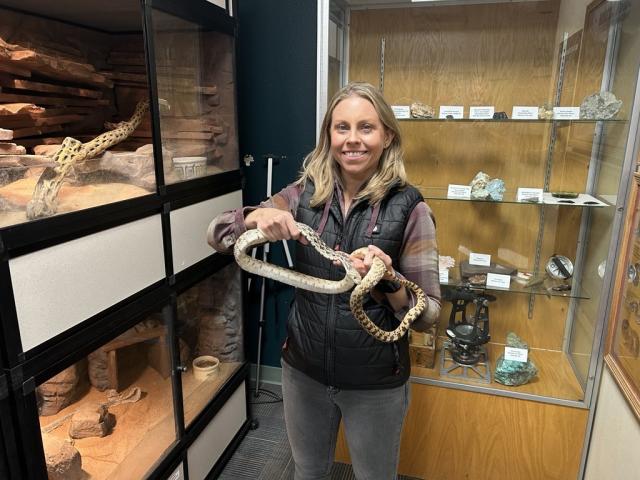
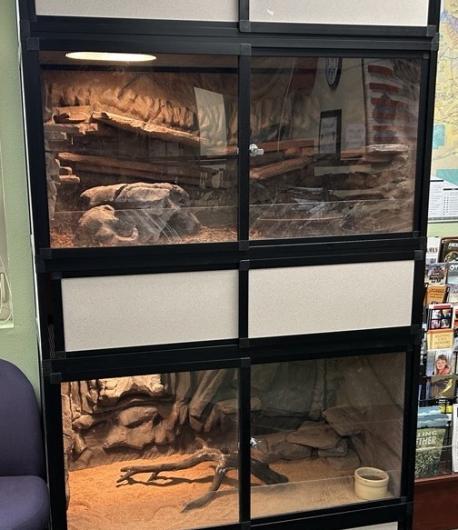
At the Bureau of Land Management (BLM)’s Kingman Field Office (KFO), wildlife education is hands-on, carefully regulated, and rooted in stewardship. Through classroom visits, community events, and demonstrations, wildlife biologist Joelle Acton helps people understand the reptiles that share the Mohave Desert landscape. To support this outreach, the field office houses a small collection of rescue reptiles. Each animal plays a role in teaching the public how to safely identify, respect and coexist with wildlife.
Acton maintains a state-issued permit through the Arizona Game and Fish Department (AZGFD) that authorizes KFO to house both non-venomous and venomous reptiles for educational purposes. The permit is renewed annually, and AZGFD is fully aware of the species being maintained and the program’s outreach mission.
Colleagues across the field office consistently point to Acton’s program as a model for combining technical expertise with meaningful public engagement. Her ability to translate complex wildlife concepts into approachable, hands-on learning has made the program a trusted and valued part of the office’s outreach efforts.
A teaching collection built on rescue
Every reptile housed at the field office is a rescue.
The non-venomous gopher snake — named “Cerbat” after surviving a roadside injury — serves as an ambassador. Cerbat is calm, tolerant of handling, and well-suited for classroom and fair demonstrations. Allowing youth to safely hold a non-venomous snake helps reduce fear and build familiarity.
The gopher snake also provides a visual comparison to venomous species like the Western diamondback rattlesnake and the Mojave rattlesnake that are in nearby habitats. Educational discussions focus on distinguishing characteristics such as head shape and behavior. Gopher snakes, for example, are known to mimic rattlesnakes — coiling, flattening their heads and vibrating their tails to produce a rattling sound. That defensive mimicry often leads to misidentification in the field.
Western diamondbacks are the most common type of rattlesnake encountered in northwest Arizona. Their venom is primarily hemotoxic, affecting blood and tissue. Mojave rattlesnakes — including the green-hued Mojave housed at KFO — possess both hemotoxin and neurotoxin components, meaning their venom can affect blood and the nervous system, potentially impacting breathing and cardiac function.
The takeaway from every presentation is consistent:
If bitten, seek medical attention immediately. Never assume a “dry bite,” and always inform medical personnel what species was involved if possible. Most bites occur when individuals attempt to handle or kill a snake. The safest response when encountering a snake is simple — create distance and walk away.
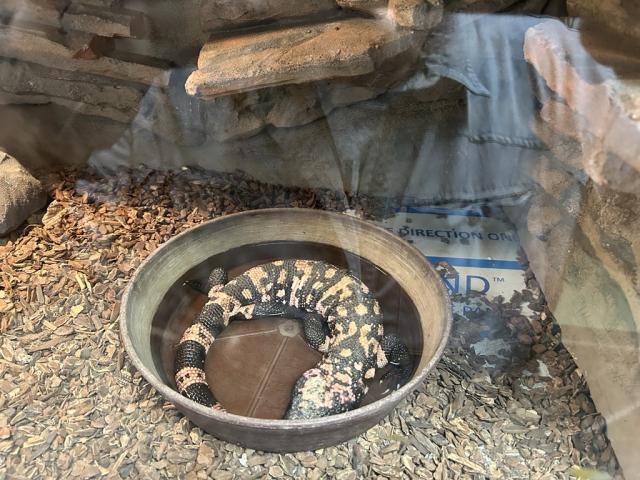
Gila monster: A state-protected native species
The program also houses “Billy Joel,” a rescued Gila monster. Gila monsters are a state-protected species in Arizona. This individual was confiscated after being discovered in illegal possession with multiple Gila monsters. Because they are protected wildlife, special authorization is required to house them — authorization that Acton maintains.
Gila monsters are one of the only venomous lizards native to North America. Though venomous, they are slow-moving and generally defensive rather than aggressive. In the wild, they rarely reach 30 years of age; in managed care, longevity can extend further due to consistent nutrition, water access, and absence of predators.
Why not relocate?
A frequent public question concerns translocation. While relocation may seem humane, research and field experience show that snakes often do poorly when they are moved long distances. They rely on familiarity with their home range for shelter, prey access and seasonal refuge. Disorientation following relocation can reduce survival rates.
Snakes also maintain relatively small home ranges compared to mammals. When provided with appropriate habitat conditions, consistent feeding and environmental enrichment, they can live stable lives in educational settings while serving a broader conservation purpose.
Education as prevention
KFO uses these reptiles in schools, community events, and public outreach settings to shift perception from fear to informed awareness. The reptiles are periodically featured at educational programs, fairs and community outreach events throughout northwest Arizona, and the public is encouraged to follow BLM Arizona communication channels, like Bureau of Land Management - Arizona on Facebook, for future appearances and outreach opportunities.
Reptiles are essential components of desert ecosystems. They regulate rodent populations, serve as prey for larger predators and contribute to ecological balance across the Mojave landscape. Eliminating them would have cascading impacts on public lands.
The program’s message is straightforward:
You do not have to like snakes.
You do have to respect them.
Understanding species differences, maintaining situational awareness while recreating, and giving wildlife space are practical steps that protect both visitors and native species.
Since 2018, Acton has led the wildlife biology program at KFO, bringing both technical expertise and direct public engagement to the field office. Through regulated rescue, careful stewardship and targeted outreach, the program demonstrates how education supports coexistence on public lands. Her commitment to public education and responsible wildlife stewardship has earned strong support from leadership and peers alike.
“Joelle has built a program that not only protects wildlife but also changes how people think about it,” said Amanda Dodson, field manager for the KFO. “Her work gives the public the knowledge and confidence to safely share the landscape with these species, and that kind of awareness is critical to long-term conservation on our public lands.”
Through regulated rescue, careful stewardship and targeted outreach, the program demonstrates how education supports coexistence on public lands.
Related Stories
- Bat Week: Celebrating the Species of BLM Eastern States
- Swainson’s Hawks: a remarkable return to California’s Central Valley
- National Public Lands Day Paddles, Plants and Caves: BLM Connects Milwaukee Youth with the Outdoors
- National Public Lands Day Volunteers Revitalize Dean S. Reservoir in Montana
- Celebrating 30 Years of California Condor Recovery at Vermilion Cliffs National Monument
Office
2755 Mission Blvd.
Kingman, AZ 86401
United States