


Rangeland Health
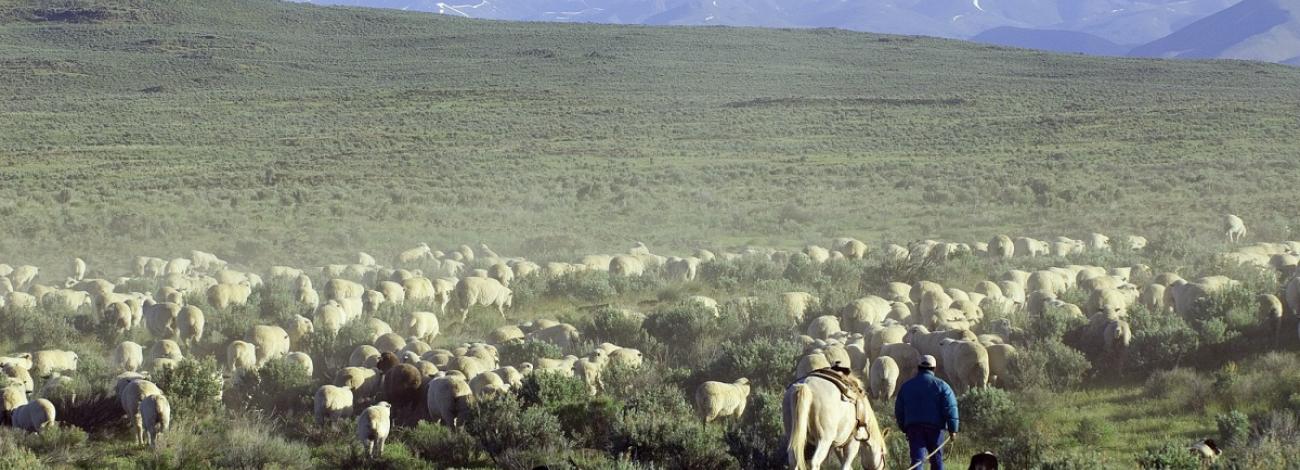
The overall goal of the BLM's rangeland management program is to ensure the health and productivity of public rangelands for the use and enjoyment of current and future generations.
To achieve desired conditions on the public lands, the BLM uses rangeland health standards and guidelines, developed in the 1990s with input from citizen-based resource advisory councils (RACs) across the West.
- Standards describe specific conditions needed for public land health, such as the presence of streambank vegetation and adequate canopy and ground cover.
- Guidelines are the management techniques designed to achieve or maintain healthy public lands, as defined by the standards. This may include seed dissemination and periodic rest, or deferment, from grazing in specific allotments during critical growth periods.
Proposed Grazing Rule
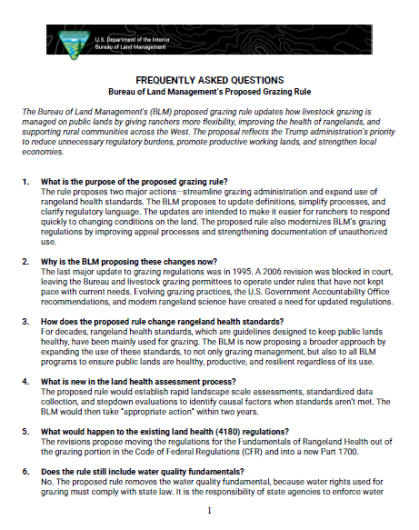
The Bureau of Land Management's (BLM) proposed grazing rule updates how livestock grazing is managed on public lands by giving ranchers more flexibility, improving the health of rangelands, and supporting rural communities across the West. The proposal reflects the Trump administration’s priority to reduce unnecessary regulatory burdens, promote productive working lands, and strengthen local economies.
Proposed Grazing Rule FAQs
- What is the purpose of the proposed grazing rule?
The rule proposes two major actions—streamline grazing administration and expand use of rangeland health standards. The BLM proposes to update definitions, simplify processes, and clarify regulatory language. The updates are intended to make it easier for ranchers to respond quickly to changing conditions on the land. The proposed rule also modernizes BLM’s grazing regulations by improving appeal processes and strengthening documentation of unauthorized use.
- Why is the BLM proposing these changes now?
The last major update to grazing regulations was in 1995. A 2006 revision was blocked in court, leaving the Bureau and livestock grazing permittees to operate under rules that have not kept pace with current needs. Evolving grazing practices, the U.S. Government Accountability Office recommendations, and modern rangeland science have created a need for updated regulations.
- How does the proposed rule change rangeland health standards?
For decades, rangeland health standards, which are guidelines designed to keep public lands healthy, have been mainly used for grazing. The BLM is now proposing a broader approach by expanding the use of these standards, to not only grazing management, but also to all BLM programs to ensure public lands are healthy, productive, and resilient regardless of its use.
- What is new in the land health assessment process?
The proposed rule would establish rapid landscape scale assessments, standardized data collection, and stepdown evaluations to identify causal factors when standards aren’t met. The BLM would then take “appropriate action” within two years.
- What would happen to the existing land health (4180) regulations?
The revisions propose moving the regulations for the Fundamentals of Rangeland Health out of the grazing portion in the Code of Federal Regulations (CFR) and into a new Part 1700.
- Does the rule still include water quality fundamentals?
No. The proposed rule removes the water quality fundamental, because water rights used for grazing must comply with state law. It is the responsibility of state agencies to enforce water standards under existing law; however, water quality considerations still influence standards and assessments. The BLM must provide 30-day notice before changing the place of use or diversion.
- How does the rule affect ranchers’ flexibility?
The proposed rule expands opportunities for:
temporary nonuse based on business or personal needs;
adjustments to turnout dates;
flexible permit terms and adaptive management; and
more streamlined permit renewals and transfers.
- Does the proposed rule change who can qualify for grazing permits?
Yes. It clarifies that permits are intended for production-oriented livestock operations, consistent with the Taylor Grazing Act. The proposal expands eligibility beyond the current “sons and daughters” provision to include any beginning rancher, who has operated a ranch less than 10 years and has never held a permit. This allows more opportunities for mentorship and herd development without surcharges.
- How does the rule treat wildland fire related decisions?
The proposed rule expands targeted grazing as a fuel reduction tool and allows certain wildland fire management decisions to take effect immediately when vegetation poses wildfire risk.
- What is the severability clause and why is it included?
The proposal states that if any provision is struck down in court, the remainder of the rule should remain in effect. This protects the overall regulatory update.
- Will there be a public meeting?
The BLM will host a virtual public information session on Tuesday, May 19, 2026, starting at 5 p.m. MT, using Microsoft Teams. Please contact Nanishka Albaladejo at nalbaladejo@scainc.com for reasonable accommodations to participate. People who use a telecommunications device for the deaf (TDD) may call the Telecommunications Relay Service at 711 during normal business hours.
- Will there be an opportunity to communicate with Federally recognized Tribes and Alaska Native Corporations on a government-to-government basis?
The BLM will host a virtual information session for Tribes in June. A calendar invite and details will be provided to Tribes.
Tribes who would like to formally consult with the BLM on the proposed regulations should reach out to their local BLM point of contact or Tribal Liaison, or the BLM Directorate of Resources and Planning at BLM_Grazing_Rule@blm.gov or 208-373-3818 to schedule a meeting with a BLM authorized officer.
- What opportunities does the public have to comment?
The public may comment on the entire proposal, including land health standards, removal of the water quality fundamental, and administrative updates. The BLM has specifically requested comments on these parts of the proposal in the introduction to the rule. Comments will be accepted until July 13, 2026.
- How can I comment?
Public comments may be submitted online at regulations.gov by entering “RIN 1004-AE82” in the search box. Written comments may also be mailed, personal, or messenger delivery to:
Bureau of Land Management
Attn: Director (630)
849 C Street NW, Room 5646
Washington, DC 20240- How long is the comment period?
The 60-day comment period began on May 12, the day the proposed rule published in the Federal Register, and concludes on July 13, 2026.
For Federal Grazing Permittees
- Does the proposed rule change how my permit is renewed?
Permit renewals would remain largely the same, but the proposal clarifies that consultation occurs after a complete application is received and is not required for mandatory renewals under the Federal Land Policy and Management Act. Renewals continue terms and conditions from the expiring permit until a new analysis under the National Environmental Policy Act is completed.
- What does it mean that grazing permits must be “production oriented?”
The proposed rule reinforces that permits are intended for livestock operations producing food or fiber. This aligns with the Taylor Grazing Act and is a longstanding practice. It is not intended for nonproduction uses such as preservation only grazing.
- How will temporary nonuse work under the new proposed rule?
Temporary nonuse:
must be applied for annually;
can be approved for resource protection or business/personal reasons (up to four consecutive years);
forage unused due to business/personal nonuse may be made available to another operator; and
forage unused for resource reasons cannot be reallocated.
- Will flexible turnout or adjusted grazing dates be easier?
Yes. The proposal allows grazing up to 21 days before or 21 days after permitted dates with the BLM’s approval, offering more flexibility under changing weather or forage conditions.
- What happens if my allotment does not meet land health standards?
Land health assessments are proposed to apply across all BLM programs, not just grazing. If livestock are identified as a significant causal factor, the BLM must take “appropriate action” within two years, which may—but does not always—include adjusting grazing terms.
Regional Information
Find standards and guidelines, rangeland management activities, and grazing information by region:
For Alaska-specific information, visit our reindeer grazing page.