


Preserving a Legacy in Stone: The Race to Save Pompeys Pillar
POMPEYS PILLAR, Mont. — Rising 120 feet above the banks of the Yellowstone River, Pompeys Pillar stands as a sandstone sentinel of the American West. For centuries, this massive formation served as a landmark for Native Americans and the explorers who followed.
Most famously, it bears the 1806 inscription of Capt. William Clark—the only remaining physical evidence of the Lewis and Clark Expedition visible on the entire trail.
But the very sandstone that has displayed this history for more than two centuries is also its greatest vulnerability. After a decade of intense study and a multiyear engineering offensive, the Bureau of Land Management concluded a stabilization project to protect this fragile monument from the silent, steady forces of natural decay.
The road to restoration began with a rumbling wake-up call in the summer of 2011. A massive sandstone block broke free from the formation, tumbled past the visitor boardwalk and smashed through the buck-and-rail fencing at the Pillar’s base. The event prompted a 14-year effort to understand and secure the rock.
By 2016, preliminary reports from the geotechnical firm DOWL confirmed that natural erosion was compromising the formation’s integrity. The situation grew more complex in 2019, when specialists from the National Park Service’s National Historic Landmark Program and Vanishing Treasures program reviewed initial mitigation plans. Their in-house expert, Dr. James Mason, identified risks so significant that the BLM closed all public access to the Pillar and its boardwalk from March 2020 through May 2021.
The BLM partnered with Itasca Consulting Group Inc. to assess the situation. Using sophisticated 3D geotechnical modeling, Itasca provided a high-tech "medical scan" of the rock, identifying exactly which outcroppings were stable and which required intervention.
To a ground-level viewer, the Pillar looks uniform, but it is a close grouping of megalithic sandstone blocks. Prehistorically a solid piece, it has transformed into an immense puzzle of interconnected sections clinging to or resting on one another, much like a giant game of Jenga.
Itasca's deep dive into the Pillar’s internal physics provided the breakthrough the BLM needed. The data proved there was no immediate, catastrophic risk to the public, allowing the boardwalk to safely reopen in May 2021 while final construction plans were engineered.
Physical transformation began in the fall of 2023 when Triptych Construction LLC began operations, matching traditional hand tools with high technology. Workers performed "scaling," using crowbars and chisels to remove hazardous fragments identified by the 3D models. These rocks were lowered by cranes in a controlled manner to protect the surrounding landscape.
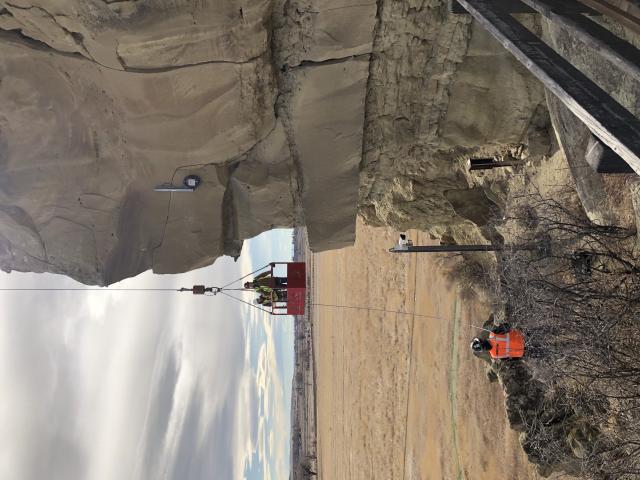
To combat the Pillar's greatest enemy—water—contractors installed an inconspicuous drainage system. They cut shallow grooves for concrete gutters and laid high-density polyethylene membranes over deep fissures to divert rainwater away from the sensitive signature area. To ensure these modern additions did not mar the historic view, the membranes were covered with a ballast of local crushed sandstone as camouflage.
Addressing the base, the team fortified the eroding shale and siltstone foundations. In areas where the rock was failing, contractors applied shotcrete—a sprayable concrete—over mesh and rebar, hand-texturing and color-matching it to the natural stone.
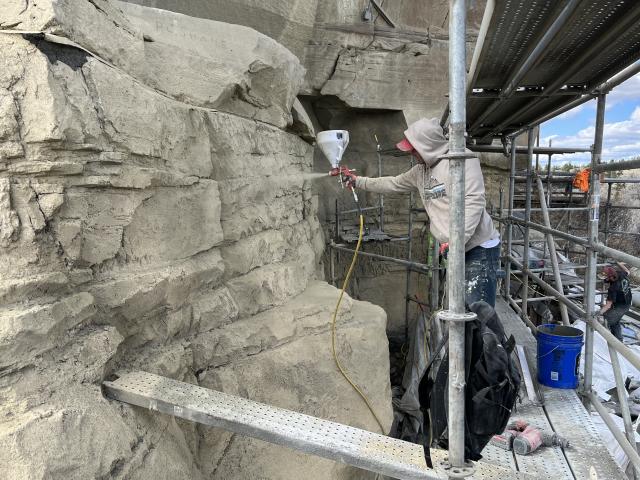
"The shale and siltstone’s primary issue was deterioration from erosion," said Josh Helm, a BLM civil engineer. "Lesser amounts of material below the sandstone results in higher pressures—which leads to failure when the stresses get too high. The shotcrete provided a protective barrier and structural support under the sandstone."
Engineers also placed numerous rock bolts into the foundation to secure the structural bond with the shotcrete. For the most precarious sections, such as the "Turtle Head" rock, steel bolts were drilled deep into the heart of the Pillar, anchored with grout, recessed and finished over.
Helm noted that one particularly large, fractured rock clinging precariously to the face of a larger block was saved by drilling from above, pinning the two sections together. Visually, a visitor would never know the hardware is there.
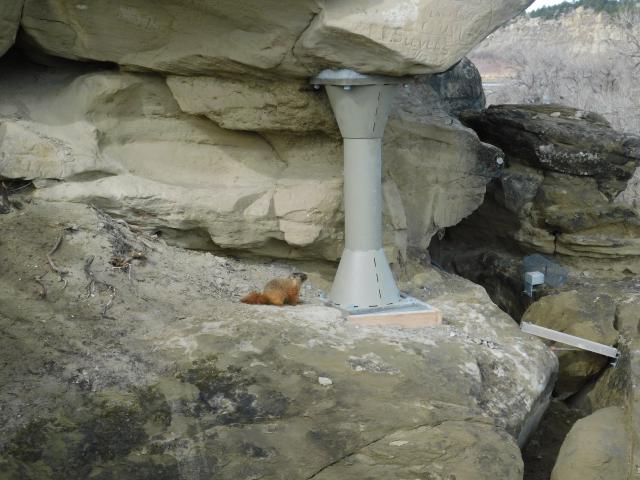
Aided by an unseasonably mild winter, crews worked steadily through the cold months, finishing on April 23, 2024. By the time the monument held its seasonal reopening on May 1, the heavy machinery was gone, leaving behind a structure that looked much as it did when Clark first saw it—yet significantly more secure.
Today, visitors looking from the boardwalk might notice strategically placed, 24-hour sensors monitoring the monolith for movement to the nth degree. The Pillar almost "breathes" with the fluctuations of time and season, expanding and contracting as the cycles of freezing, thawing, baking heat and soaking rain continue.
Especially meaningful considering the 250th anniversary of our nation’s founding, the successful stabilization of Pompeys Pillar reflects the core mission of the Department of the Interior and the BLM: to protect and manage our cultural heritage so that future generations have the same opportunities to experience this unique feature of the American landscape.
This project was never about altering the Pillar, but about buying it more time against the elements. Through a blend of advanced modeling and careful masonry, the BLM has secured this vivid registry of the American story.
For more information or to plan a visit to Pompeys Pillar National Monument visit: https://www.blm.gov/visit/pompeys-pillar-national-monument.
Related Stories
- National Public Lands Day Volunteers Revitalize Dean S. Reservoir in Montana
- Nails and Tires Don’t Mix
- Pipestone Roars to Life as Community Comes Together for National Public Lands Day
- Healing Hooves: How a Once‑Wild Burro is Bringing Joy Across Pennsylvania and Competing Nationally
- Billings Field Office completes abandoned uranium mine closure work in the Pryor Mountains
Office
5001 Southgate Drive
Billings, MT 59101
United States