Planting for the Future: BLM Staff and Volunteers Rebuild the Jupiter Inlet Lighthouse Shoreline
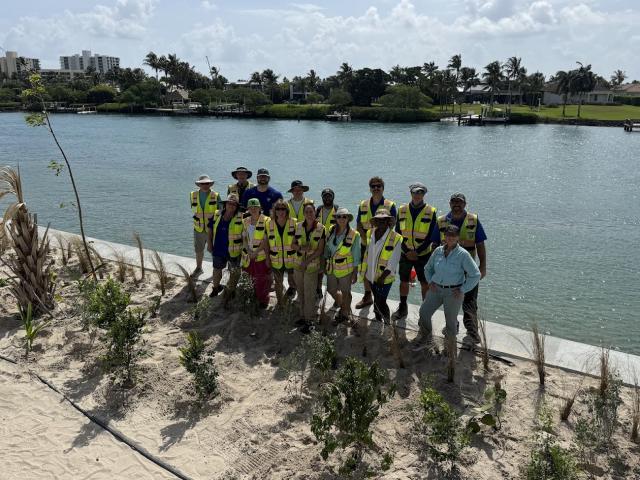
Group of people wearing safety vests standing on sandy shore near a body of water with greenery and buildings in the background.
Group photo of the BLM staff, volunteers, and ACE interns who contributed to the plantings, standing in front of the 147 successfully planted terrestrial plants. Photo credit Holly Bratcher, ACE Intern L – R back: Wes Gilmer, Mining Engineer; volunteer; Anthony Tridente, GIS Specialist; Joe Edmonds, Planning and Environmental Specialist; Will Harris, Realty Specialist; Michal Panek, Natural Resource Specialist; volunteer; Peter DeWitt, ONA Manager L – R front: Angela Dennis, Administrative Support Assistant; Sarah, volunteer; Shayne Banks, Acting District Manager, SSDO; Skye Henderson, ACE intern; volunteer; Samirra Felix, Geologist/Mining Engineer; volunteer

In celebration of Memorial Day, the Bureau of Land Management’s Jupiter Inlet Lighthouse Outstanding Natural Area (ONA) in Jupiter, Florida hosted a shoreline tree and vegetation replanting effort on May 27, as part of the ONA’s ongoing Great American Outdoors Act (GAOA) Shoreline Stabilization Project. The initiative aims to strengthen and restore the fragile Indian River shoreline using native plant species that will enhance habitat stability and long-term ecological resilience.  
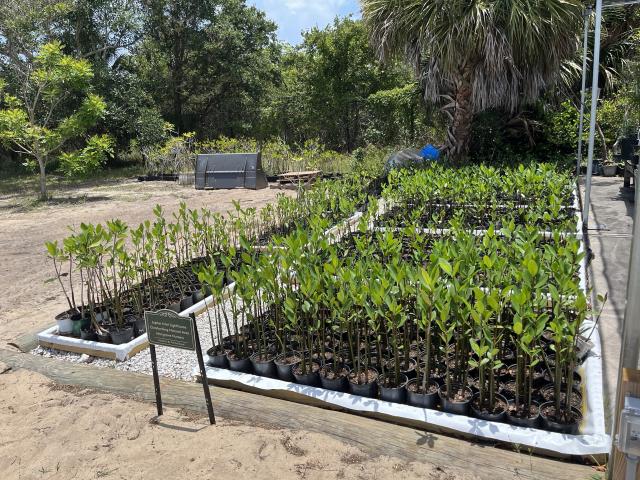
Rows of young mangrove saplings in black pots arranged neatly on white plastic sheeting outdoors under a sunny sky.
Mangrove trees that were planted along the rocks and sand of the northern part of the shoreline stabilization project in the afternoon. Mangroves help prevent erosion and aid shoreline stabilization with their root systems, which can grow in rock faces, removing sediment deposits, filtering pollutants from the water, and they are also excellent carbon capture plants, storing carbon dioxide and other greenhouse gases. Photo credit Joe Edmonds, Planning and Environmental Specialist

Before the day’s restoration work began, staff from the Southeastern States District Office (SSDO) enjoyed a guided tour of the historic site, including the steep and iconic climb up the lighthouse’s 105 steps. At the top, they were greeted with expansive, picturesque views of Jupiter and the greater West Palm Beach area, an especially memorable experience for several SSDO employees visiting the scenic location for the first time.  
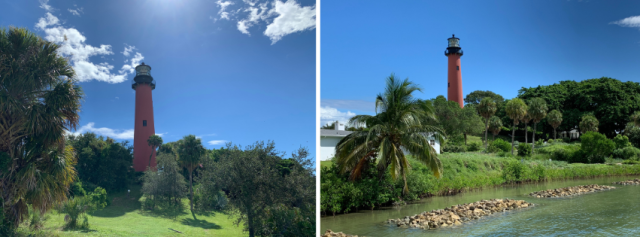
Two views of a red lighthouse surrounded by palm trees and greenery under a bright blue sky.
Two views of the Jupiter Inlet Lighthouse and the grounds. The lighthouse sits on the banks of where the Indian River flows into the Loxahatchee River, which subsequently flows into the Atlantic Ocean. Photo credit Joe Edmonds, Planning and Environmental Specialist
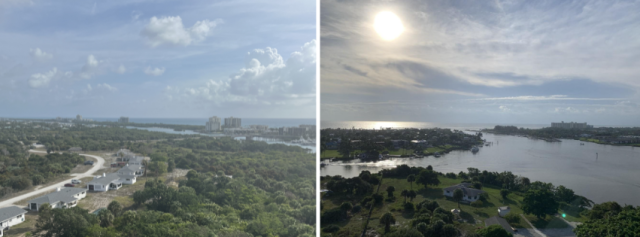
Side-by-side aerial views of a coastal area with greenery, houses, water bodies, and distant buildings under partly cloudy skies.
One can see for dozens of miles from the Jupiter Inlet Lighthouse’s gallery deck, taking in the greater West Palm Beach area. The Indian River is shown in the top photo and in the northern part of the lower photo, where it flows into the Loxahatchee River, to the right. The Atlantic Ocean is visible in the background. Photo credit Joe Edmonds, Planning and Environmental Specialist

The workday proved to be exceptionally productive. Over the course of the morning, 16 participants—including onsite ONA staff, American Conservation Experience (ACE) interns, local volunteers, and SSDO employees who traveled from Flowood, Mississippi—came together to conduct a large-scale replanting along the shoreline. Their collective labor resulted in the successful planting of 147 native terrestrial plants as well as 135 mangroves, far exceeding the original expectations for the event. The team’s enthusiasm and efficiency ensured the project went “above and beyond” its initial goals, contributing meaningful progress to the GAOA-funded stabilization effort.  
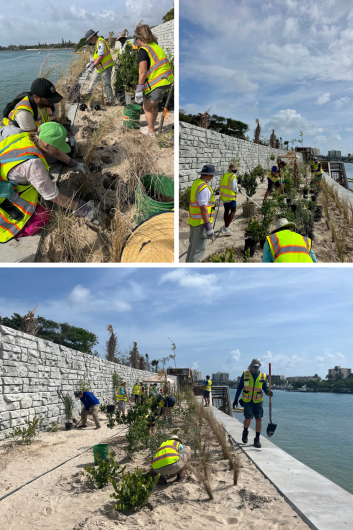
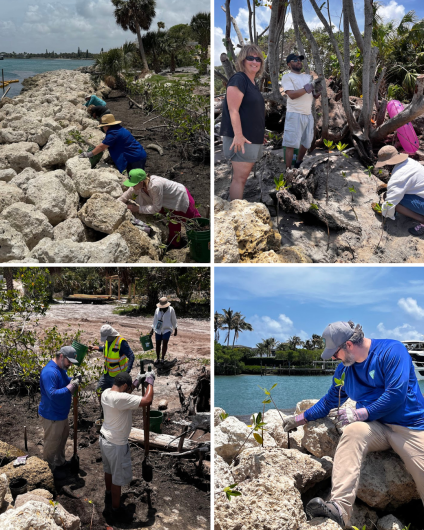
Volunteers in safety vests planting vegetation along a waterfront stone wall under a partly cloudy sky.
The native terrestrial planting in the morning, along the southern part of the shoreline stabilization project. Photo credits Holly Bratcher, ACE intern; and Joe Edmonds, Planning and Environmental Specialist
Volunteers planting mangrove saplings along a rocky shoreline under a clear sky near calm water.
BLM staff and volunteers planting the mangrove trees in the afternoon. The mangroves are able to root in the sand and in the rock faces, subsisting on seaweed nutrients. As with the terrestrial planting, the staff and volunteers planted far more trees than the original target count, a total of 135 mangroves! Photo credit Holly Bratcher, ACE intern


After completing the restoration work, SSDO staff took advantage of the opportunity to explore the surrounding West Palm Beach area. Their afternoon included visits to the Loggerhead Marinelife Center, where they viewed active sea turtle rehabilitation, a relaxing walk along nearby Juno Beach, and additional sightseeing that highlighted the natural beauty and cultural richness of Florida’s Atlantic coast.  
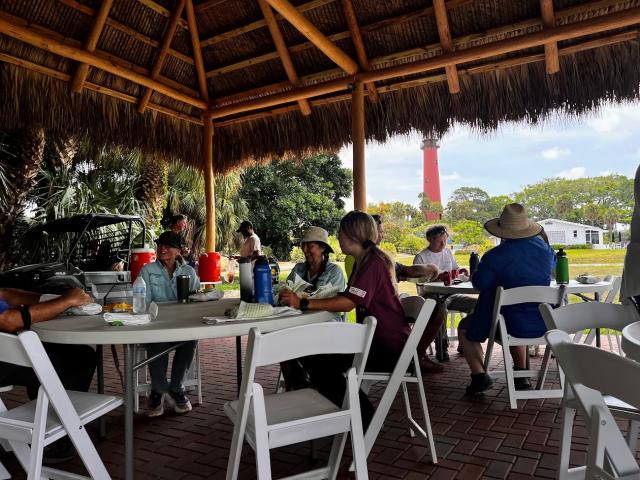
Group of people sitting and chatting under a thatched roof pavilion with a red lighthouse visible in the background.
Staff broke for lunch after the native terrestrial planting, refueling for the equally critical mangrove planting north of the terrestrial plant area.

The Jupiter ONA Memorial Week workday stands as a testament to the dedication of BLM staff, interns, and volunteers who continually invest time and energy into stewarding public lands. Their contributions not only strengthened a vital shoreline but also deepened the connections among staff across regions, capturing the collaborative spirit that defines the Bureau of Land Management’s mission.   

Story by:

Joseph Edmonds, Planning and Environmental Specialist

Blog Topic: