


Lake Havasu Fisheries Improvement Program is the gift that keeps giving
If you celebrate Christmas, you are familiar with the age-old debate: real or artificial tree. There are definite advantages to both. Artificial trees are lower maintenance, fire resistant, and cost effective due to their reusability; they can come prelit and in a variety of styles and colors. Real trees look, feel, and smell…real. Purchasing a real tree often supports local farms, businesses and organizations, they are a renewable resource, and they can be repurposed after the holiday whereas artificial trees are largely non-biodegradable. If your tradition is a real tree, or if you decide on one this year, what will you do with it after the holiday? The Bureau of Land Management looks for ways to reuse them. If you are in the Lake Havasu area, BLM manages a project with the support of local partners to build a fish habitat with the holiday staple.
Lake Havasu is a reservoir along the Arizona-California border, a manmade settling basin for the Parker Dam, which impounds a stretch of the Colorado River. The Bureau of Reclamation built the dam – the deepest in the world – in 1938 to create a water and hydro-power source for communities on both sides of the river. The lake has since become a destination for recreational boaters and anglers who fish for striped, large- and small-mouthed bass, catfish, and redear sunfish. The current world-record redear was caught in Lake Havasu in 2021.
BLM manages boating access to the lake as well as the 73 campsites on its Arizona shore (accessible only by boat). Activities on the shoreline attract thousands of visitors whose spending brings in more than $150 million to the local economy each year. Many of these visitors come to fish, either at their leisure or in organized tournaments.
BLM Fisheries Biologist Rachel Wirick leads the Lake Havasu Fisheries Improvement Program – a unique partnership of federal, state and local organizations that work to build a sustainable, high-quality fishery in the reservoir.
“There really was no submerged habitat in Lake Havasu. There were places that were rocky and sandy, but there was nothing to really hide behind and no food sources for fish. It was just kind of flat and barren, with the current moving through to Parker Dam,” said Wirick.
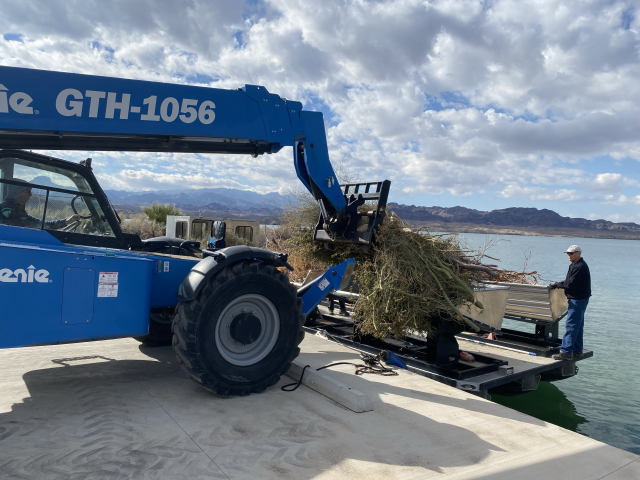
This is why the addition of brush and Christmas trees became essential. The BLM Partners Point facility collects brush trimmings year-round and post-holiday pine trees to repurpose as sources of food and refuge for the various fish species.
“The additions really are vital because it’s the only nutrients that are going into the lake to support the fish,” said Wirick. It also keeps the trees and brush out of the city landfill.
Wirick said the idea of repurposing Christmas trees to enhance fishing opportunities originated in the 1960s with individuals who wanted to improve small fishing ponds on their own properties. Since the early 1990s, the Lake Havasu partnership has scaled up the idea to fit the larger body of water.
“Though I know there are a lot of habitat improvement projects being done across the country, I’m not aware of anyone else doing what we do on this scale at Lake Havasu,” said Wirick, noting that in 2024, the Arizona Game and Fish Department launched an effort to replicate the Havasu Christmas tree project at Alamo Lake in the Yuma area.
Enough materials are collected to allow for sustained drops year-round. As the brush bundles and pine needles decompose over several months, they become the nutrient base for a food web. Tiny insect larvae, snails, mussels, crayfish and plankton feed on the decomposing material, then fish eat these creatures. Smaller fish become prey for the larger species, but they can also evade predators by hiding among the tree branches once the needles and leaves have dropped. At the top of the food chain, redear, bass and catfish are then nourished to reach the sizes that anglers prize.
The work of placing the trees and brush requires a cadre of volunteers who help bundle and place the donated materials. In return, they gain an advantage in knowing exactly where these fishing “hot spots” are before others discover them. Volunteers good-naturedly safeguard this information, using it to lure friends into helping in exchange for the knowledge.
“There’s no way that I could do this on my own,” said Wirick. “We have a really great, active group of about 20 volunteers, many are fishermen, but everyone just wants to give something back to their community. Please join us!”
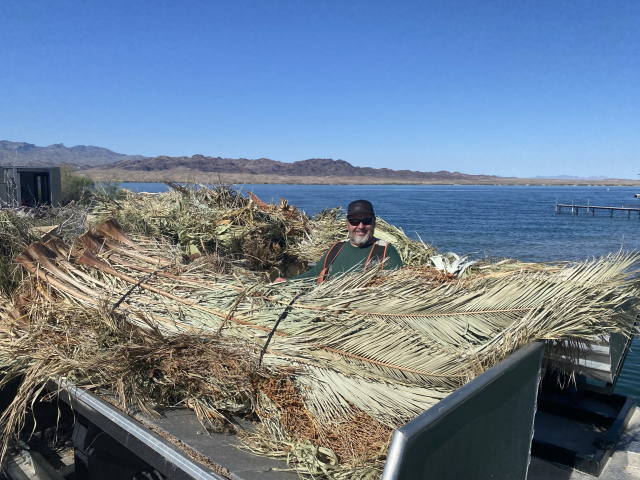
There is an increasing number of Christmas trees donated each year, from 68 trees just three years ago to 560 last year. In addition to getting trees to repurpose from the public, the program gets unsold Christmas trees donated from the local Home Depot, Lowe’s, and Masonic lodge. The program also partners with local landscapers to get donated brush throughout the year and a local waste management service that donates dumpsters for tree and brush collection for about three weeks after Christmas set up next to the Lake Havasu City Aquatic Center.
Donated trees and brush supplement the lake’s habitat for up to 10 years, making these bundles the “gifts that keep on giving.” For additional information, such as how to volunteer or donate, contact the BLM Colorado River District Office at 928-505-1200 or BLM_AZ_LHFOWeb@blm.gov.
Related Stories
- Fossils, furs and a few sparks at Kemmerer Outdoor Discovery Day
- One Mile Closer
- Signs of Collaboration: Protecting Tortoises on Arizona Public Lands
- BLM Showcases Local Recreation Treasures Ahead of National Hunting and Fishing Day
- BLM Arizona and Arizona Association of Conservation Districts: A Model Partnership for Landscape Conservation