


2026 Cedar Mtn HMA Wild Horse Gather
Purpose of Gather:
The BLM is conducting gather operations to reduce overpopulation in support of healthy wild horses on healthy public rangelands. With few natural predators, wild horse herds increase 15-20 percent annually, doubling in size every 4-5 years. Without management, herds can quickly outgrow what the available forage and water on the land can support. Constant overpopulation can degrade resources critical for wild horses and other wildlife, and can lead to starvation and thirst for the wild horses themselves, especially during winter and dry summer seasons. The appropriate management level for this herd management area is from 190 to 390 animals with a current estimated population of 660 horses.
Details of Gather:
The BLM plans to gather and remove approximately 500 excess wild horses from the Cedar Mountain Herd Management Area. The appropriate management level for the Cedar Mountain herd is 190-390 wild horses based on the available forage, water and other authorized uses, such as wildlife habitat and livestock grazing. The latest estimated population size is 660 wild horses. Once the gather is completed, BLM will perform a post gather population inventory survey. If the results of the survey find that the population is below AML, horses will be selected and returned to the HMA.
Under BLM supervision, contractors will conduct gather operations with assistance of one or more helicopters that will guide animals on the range into temporary gather corrals. The careful use of helicopters allows the BLM to safely and efficiently move wild horses across large, rugged landscapes while reducing stress and minimizing risks associated with prolonged pursuit on horseback or land-based vehicles.
The safety and welfare of wild horses during gather operations is a top priority for the BLM. All operations will be conducted in full compliance with the BLM’s Comprehensive Animal Welfare Program.
Public Observation:
The BLM will temporarily close certain public lands around gather locations to public access, including a prohibition on the use of unmanned aerial vehicles (“drones”), in accordance with 43 CFR 8364.1. The closures are necessary to protect the wild horses, as well as public health and safety. BLM will notify the public about the duration and location of temporary closures in accordance with 43 CFR 8364.1, including on the gather webpages.
Opportunities are available for the public to observe gather operations through BLM-escorted tours as long as conditions remain safe for both the horses and participants, and gather operations are not disrupted.
What to Expect
Observers should prepare to spend multiple hours at the observation site, in and outside their vehicles, and must provide their own transportation, water, and food. No public restrooms will be available. The BLM recommends weather-appropriate footwear and neutral-colored clothing. No signage, large displays, or colorful equipment that could cause distractions will be allowed. Binoculars, high-zoom photo lenses, and four-wheel-drive, high-clearance vehicles are also strongly recommended.
Reservations
- Daily public observation tours for the Cedar Mtn Gather are scheduled to begin Nov. 8, departing near Grantsville, Utah in the early morning.
- Observation schedules and locations are subject to change based on weather, safety conditions, and operational needs.
- Observation participation is limited to 10 people per day to reduce operational risk and help ensure safe gather operations for both the horses and participants.
- Daily reservations are available on a first-come, first-served basis. In periods of high demand, the BLM will prioritize opportunities for credentialed media and individuals who have not previously observed gather operations during the gather.
- Reservation requests must be received by 5 p.m. Mountain Time on the day before the requested observation date.
- Multiple-day reservations and advance reservations for future dates will not be accepted.
- To request a reservation to observe, leave a message on the Utah Gather Hotline at (801) 539-4050 with the name, phone number, and affiliation (if any) for each person in your party, along with the total number of people and vehicles attending.
- The BLM will contact individuals by text or phone call with confirmed reservations by 8 p.m. Mountain Time and provide meeting location and departure details.
Contact Information
Utah Gather Hotline: (801) 539-4050
For questions about media observation, contact BLM Utah External Affairs.
Adoption Information:
The Sutherland Off-Range Corral near Delta, Utah will receive 150 stallions from the Cedar Mountain HMA. The remaining 350 horses from Cedar Mountain will be transported and held at the Axtell Off-Range Corral. All gathered wild horses will be checked by a veterinarian and readied for the BLM’s wild horse Adoption and Sale Program. Those that are not placed into a new home will be cared for in off-range pastures, where they live off the rest of their lives on grass pastures. Learn more about the BLM’s Adoption and Sale programs.
Background:
Wild horses have occupied the Cedar Mountains since the late 1800s. It is suggested that the original stock was controlled by the Standard Horse and Mule Company that provided remounts for the U.S. Army. However, many of the horses on the Cedar Mountains are descendants of horses that escaped from local ranches. In recent years horses have been introduced from other Herd Management Areas from Nevada, Oregon, Wyoming and other HMAs from within Utah.
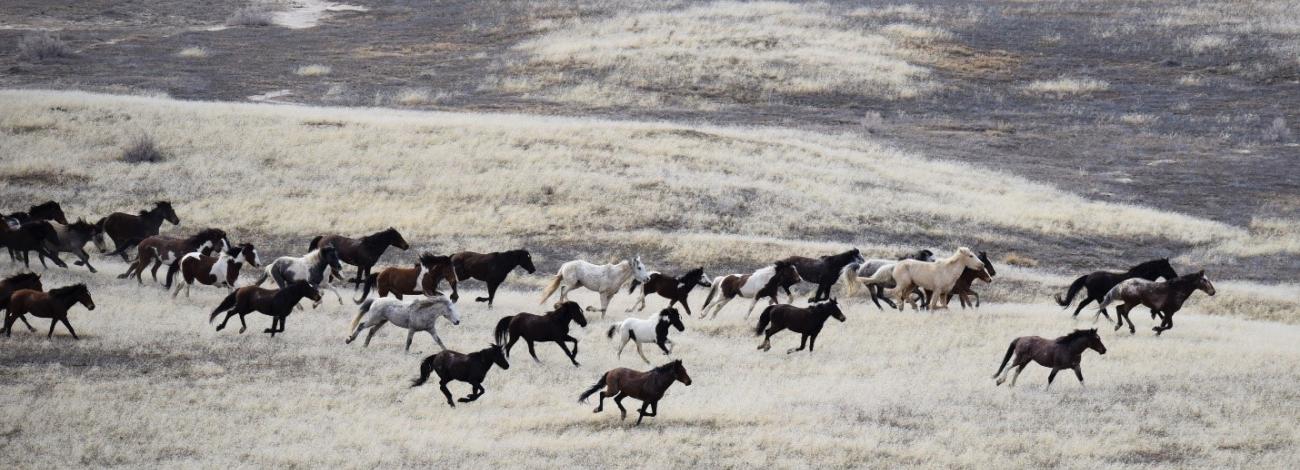
The dominant colors within the herd area are bay and black. Other colors found include pinto, sorrel, red and blue roan, buckskin, palomino, and gray.
The wild horses on the Cedars are classified as average in size. Mares weight 750 to 800 pounds and stallions weigh 850 to I,000 pounds.
Location
The Cedar Mountains Herd Management Area (HMA) is located 45 miles west from Salt Lake City, Utah, and south of I-80. The HMA extends from Hastings Pass southward to the Dugway Proving Grounds.
Size
The HMA contains 197,275 acres of BLM lands and 14,317 acres of Federal, State-, and privately-owned land for a total of 211,592 acres.
Topography/Vegetation
Vegetation varies from salt desert shrub and sagebrush to grass-juniper and juniper barren ground type at the higher elevations. Majority of the area is made up of cheatgrass as the dominant vegetation type.
The extreme valley bottoms on the east side of the Cedar Mountains are in the greasewood shrub type due to high exchangeable sodium. Annuals such as cheatgrass, Halogeton and Russian thistle have invaded large areas. A fire interval of three to five years has established in these areas. As a result, the salt desert shrub and sagebrush types are largely absent within cheatgrass areas. Furthermore, fire rehabilitation seedings on the bench areas have had limited reestablishment of shrubs. Cheatgrass and seeded wheat grasses have resulted in abundant forage throughout Skull Valley.
Water sources within the HMA include stock reservoirs, springs and intermittent streams fed by winter snows and spring runoff.
Resource damage has occurred especially near water sources where distinct horse trailing is evident. Water flow from sources in the area has decreased and, in some instances, ceased altogether. Emergency gathers were completed in 2004 and 2018 due to the lack of water resources for the horses in the HMA.
Wildlife
The Cedar Mountain HMA areas provide important forage, water, shade, and cover for a variety of wildlife. The higher elevation portion of this area is dominated by juniper and provides for species such as elk, mule deer, and various migratory birds. The foothills consist of desert shrub and species like pronghorn which prefer this type of habitat.
The foothills of the Cedar Mountains provide breeding, nesting, and foraging habitat for numerous raptor species. Some of the raptor species that nest and/or use the area include golden eagle, prairie falcon, red-tailed hawks, Swainson's hawk, ferruginous hawks, a variety of owl species, and other raptors.
Migratory birds in North America are primarily neotropical species that nest in the United States during the summer and migrate south. The HMA is utilized by juniper-obligate and sage-obligate bird species as well as transient and migratory populations of birds in the spring and fall of each year.
Gather Status
The gather will begin on Monday, November 2, 2026.