


2026 Canyonlands HMA Bait Gather
Purpose of Gather:
The gather decision supports the BLM’s ongoing efforts to remove excess wild burros from within and surrounding the Canyonlands Herd Management Area (HMA) in Wayne County in order to maintain a healthy balance between burro populations and available rangeland resources. This balance is managed through the established Appropriate Management Level (AML), which for the Canyonlands HMA is 60–100 animals.
Details of Gather:
The Canyonlands Herd Management Area (HMA) is located approximately 60 miles south of Green River in Wayne County, Utah, east of Canyonlands National Park and Horseshoe Canyon, and west of Glen Canyon National Recreation Area.
The HMA consists of approximately 77,311 acres of BLM-managed public lands, 10,465 acres of State lands, and 1,616 acres managed by the National Park Service, for a total of 89,392 acres.
Gather operations are scheduled to occur from May 1, 2026, through Aug. 30, 2026, or until the Appropriate Management Level (AML) is achieved.
Public Observation:
Public viewing will not be permitted at bait trap sites in order to ensure public and staff safety, minimize stress on the animals, and maintain the effectiveness of gather operations.
Adoption Information:
All excess wild burros removed from the range will be transported to the Axtell Off-Range Contract Wild Horse Facility in Axtell, Utah, where they will receive veterinary evaluations and be prepared for the BLM’s Wild Horse and Burro Adoption and Sale Program. Burros that are not adopted or sold into private care will be relocated to off-range pastures, where they will continue to receive long-term care for the remainder of their lives.
For more information about adopting or purchasing a wild burro, visit the BLM Wild Horse and Burro Program webpage at BLM Wild Horse and Burro Program.
Background:
History
Wild burros are descendants of animals that originated in the desert regions of northern Africa and the Arabian Peninsula, where they were valued for their strength, endurance, and ability to travel long distances across harsh terrain carrying supplies and goods. Burros were later domesticated in Europe and eventually brought to North America by Spanish explorers, including Christopher Columbus, beginning around 1495.
During the settlement of the American West, prospectors and miners relied heavily on burros while traveling across remote desert landscapes in search of gold and silver. Many burros survived even when their owners did not, while others escaped or were intentionally released. The descendants of these animals make up many of the wild burro herds found on western public lands today.
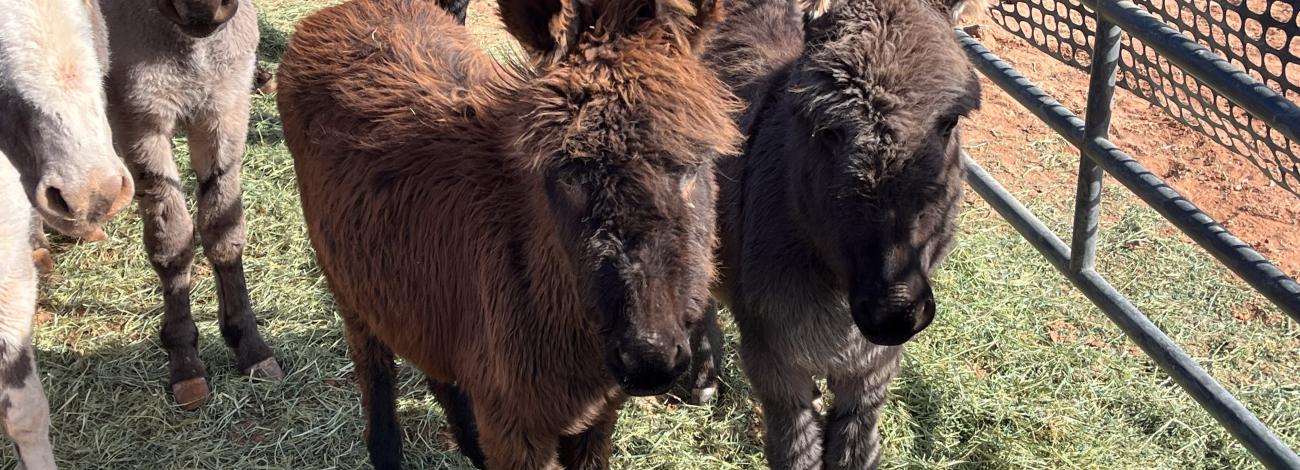
Wild burros are known for their long ears, short upright manes, and sturdy build. They can stand up to five feet tall at the shoulder and generally weigh between 400 and 500 pounds. Coat colors vary widely and may include black, brown, gray, white, or pinto patterns, with some animals displaying stripes, spots, or speckling.
Location
The Canyonlands Herd Management Area (HMA) is located approximately 60 miles south of Green River in Wayne County, Utah, east of Canyonlands National Park and Horseshoe Canyon, and west of Glen Canyon National Recreation Area.
Size and Appropriate Management Level (AML)
The HMA consists of approximately 77,311 acres of BLM-managed public lands, 10,465 acres of State lands, and 1,616 acres managed by the National Park Service, for a total of 89,392 acres.
The Appropriate Management Level (AML) for the Canyonlands HMA is 60–100 wild burros.
Topography and Vegetation
Topography within the HMA is highly variable and ranges from flat desert grasslands with desert shrub communities to rugged terrain and rolling foothills shaped by numerous drainages and canyons.
Wild burros feed on a variety of desert vegetation, including grasses, Mormon tea, palo verde, and plantain. While some moisture is obtained from vegetation, burros require access to drinking water year-round and generally remain within 10 miles of available water sources.
Wild burros are most commonly observed foraging during daylight hours, although during the hotter summer months they are more active at night and during the early morning hours. On average, a wild burro consumes approximately 6,000 pounds of forage annually.
Wildlife
A variety of wildlife species inhabit the HMA, including mule deer, coyotes, porcupines, desert cottontails, black-tailed jackrabbits, and numerous songbird species. Other desert wildlife commonly found in the area include rock squirrels, antelope squirrels, chipmunks, lizards, snakes, hawks, and eagles.
Additional Information
For more information about adopting or purchasing a wild horse or burro, visit the BLM Wild Horse and Burro Program webpage.
- Daily Gather Reports
Friday, May 8, 2026
Summary: (Gather status, temp and weather conditions)
Animals Gathered: 2 (0 Jacks, 2 Jennies and 0 Foals)
Animals Shipped: 2 (0 Jacks, 2 Jennies and 0 Foals)
Animals Treated with Fertility Control: 0
Animals Released: 0 (0 Jacks, 0 Jennies and 0 Foals)
Deaths: 0
- Sudden / Acute: 0
- Pre-existing / Chronic: 0
Gather Status
As of May 8, 2026.
Animals Gathered: 2
2 Wild Burros (0 Jacks, 2 Jennies, and 0 Foals)
Animals Shipped: 2
2 Wild Burros (0 Jacks, 2 Jennies, and 0 Foals)
Animals Treated with Fertility Control: 0
0 Wild Burros (0 Jacks, 0 Jennies, and 0 Foals)
Animals Released: 0
0 Wild Burros (0 Jacks, 0 Jennies, and 0 Foals)
Deaths: 0
-Sudden / Acute: 0
-Pre-existing / Chronic: 0
Scroll to the bottom of this gather page for detailed “Daily Gather Reports"