


Celebrate Halloween with bat trivia on BLM-managed lands
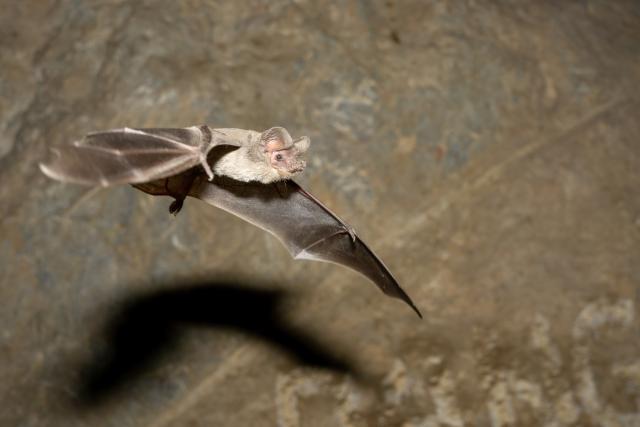
Bat Week — held the last week in October — celebrates the role of bats in nature and all that these amazing creatures do for us. Check out 10 fun facts you may not know about bats on Bureau of Land Management (BLM)-managed lands.
BLM-managed lands — including deserts, woodlands, and subterranean sites — are home to more than 60% of bats species in the United States.
The U.S. Desert Southwest is notable for its quantity and quality of bat habitat. Arizona is remarkable for having 28 species of bats, most of which are found on BLM-managed lands.
Bats are important pollinators of cacti, agave, mangoes, bananas and figs, among other plants. Saguaro cacti occur on BLM-managed lands in the Sonoran Desert in Arizona and rely heavily on nectar-feeding bats for pollination.
Bats have been on the Earth for millions of years, providing vital ecosystem services in the form of insect pest consumption, plant pollination, and seed dispersal, making them essential to the health of many BLM-managed landscapes.
In the U.S., bats are most commonly insectivorous, or insect-feeding.
Bats are important in the food web as pest control for insects such as moths and beetles that can decimate crops in the U.S. Bats feast on insects each night, adding up to more than $3.7 billion worth of pest control each year in the U.S. Bats can eat up to 1,000 mosquito-sized insects in a single night!
The smallest bat species on BLM-managed lands is the western small-footed bat, at four grams, the equivalent of two playing cards. They are most common in arid and semiarid habitats, such as deserts and badlands, but may be found in pine or juniper forests, especially at higher elevations.
Although abandoned mines pose human safety concerns, these sites often serve as excellent habitat for some bat species. The BLM partners with Bat Conservation International and state fish and wildlife agencies to construct protective closures, including gates, designed to provide for human safety and ensure safe passage for bats to enter and exit.
White-nose syndrome has been spreading east to west across the U.S. over the last 20 years. It is now found in all BLM states except Alaska. Measures are in place to minimize the spread and impact of white-nose syndrome, such as cleaning gear and minimizing disturbance. Get more information about white-nose syndrome.
The BLM partners with Bat Conservation International to restore bat habitat on our public lands, as well as to inventory abandoned mines for bat habitat. If abandoned mines contain bat habitat, they are secured for human safety while keeping the bat habitat intact. In addition, springs, wet meadows, and water are highly important to bats for both water and for their insect prey. Therefore, spring improvements and riparian restoration all support healthy habitats for bats.
Related Content
Related Stories
- BLM’s Meadowood Special Recreation Management Area Celebrates 25th Anniversary
- Tracking Bats Across Big Skies: BLM Lands Help Expand Montana’s Motus Network
- Rose Guano Cave Important Stop for Migrating Bats on BLM-Managed Public Lands in Nevada
- Beyond the Badge: Protecting People and Public Lands
- Celebrating the Species of BLM Eastern States for Bat Week
Office
1849 C Street NW
Washington, DC 20240
United States