


Tracking Bats Across Big Skies: BLM Lands Help Expand Montana’s Motus Network
On Bureau of Land Management public lands in central Montana, two newly installed wildlife-tracking towers are already helping researchers uncover the hidden movements of bats across the continent.
“As a species, bats play an important role in our environment by controlling insect populations that may otherwise harm crops and forests, and transmit diseases,” said Rebecca Newton, wildlife program lead for the BLM Montana/Dakotas. “Currently, many bat species across the country are threatened by a fatal disease called White-Nose Syndrome. Because of their nocturnal behavior, small size, and roost preferences, bats are challenging to study – and challenging to help in the case of WNS. The more we can do help state wildlife managers ensure the survival of this important and beneficial animal, the better off we will be.”
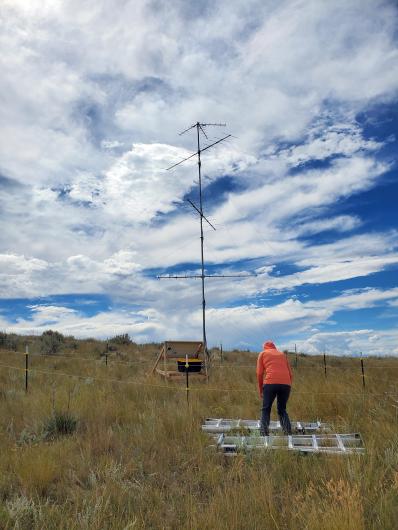
BLM Montana/Dakotas staff approved installation of Motus towers on BLM lands as part of a broader effort by Montana Fish, Wildlife & Parks to build a statewide network of automated telemetry stations that detect and collect data on flying wildlife in their proximity. The most-recently installed towers were placed in the Upper Missouri River Breaks National Monument during late-summer: one in the Bullwhacker area and another near 8-Mile Bench.
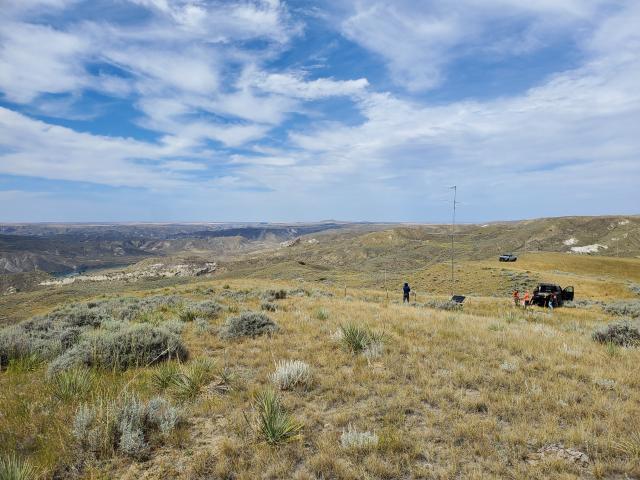
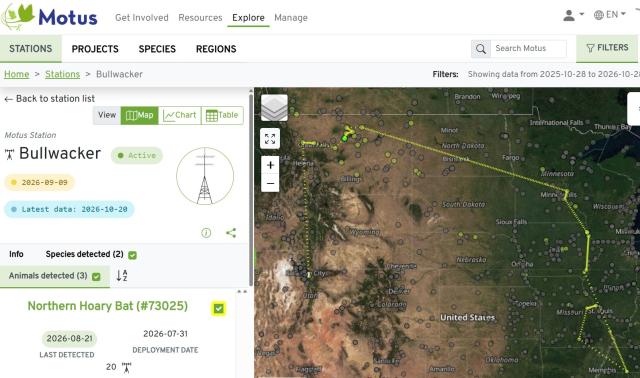
The value of the BLM-supported network became clear almost immediately. Before the second tower was fully online, the Bullwhacker station detected a northern hoary bat during the night of Aug. 20 that had been tagged in Utah before traveling north and continuing toward the Midwest. The detection highlighted both the distances bats can travel and the importance of public lands in connecting wildlife-movement data across state boundaries.
BLM Public Lands Help Fill Strategic Gaps
Across Montana, multiple BLM field offices have supported the network by reviewing and approving tower locations on public lands, and even helping with tower installation as FWP expands the statewide system. Tower placement is focused along river corridors and other strategic locations where wildlife movements are likely to be detected.
For BLM Montana/Dakotas, the new Motus station installations facilitated by the monument and the Miles City, Butte, Dillon, Lewistown, Glasgow, and Billings field offices demonstrate how public lands can support landscape-scale wildlife science. By providing locations for receiving stations, BLM-managed lands help researchers collect information that would otherwise be difficult or impossible to obtain.
“The tracking devices that Motus towers are designed to detect can be much smaller than some satellite transmitters popular for tracking wildlife movements,” said Newton. “This means that small and lightweight species, like bats, small birds, and even large insects like monarch butterflies can now be tracked using this technology.”
A Statewide Tracking Network
FWP is building the Montana network as part of the international Motus Wildlife Tracking System and plans a network of 50 stations across the state, forming a “fence” of detection sites that can record movements of bats, birds, and other small wildlife, as noted in a recent Yellowstone Public Radio interview.
Motus technology is especially promising for bat research. Unlike larger animals that can carry GPS transmitters, bats require extremely small tracking devices. Motus stations detect signals from lightweight radio tags attached to individual animals, enabling researchers to document movements that are largely invisible to people on the ground.
Filling Critical Knowledge Gaps
Bats are among the least understood mammals in North America. Many species migrate seasonally, use different habitats throughout the year and travel primarily at night, making them difficult to study using traditional monitoring methods.
Motus data can help researchers identify migration routes, seasonal habitat use and connections between populations across broad landscapes. Those insights can support informed conservation decisions and improve understanding of threats facing bat populations, including white-nose syndrome. WNS was first documented in Montana in 2020, in a Phillips County bat colony and quickly appeared in other colonies across the state. It was most recently detected this year in Glacier and Yellowstone national parks’ bat populations.
Connecting Montana to a Larger System
Each Montana station contributes to an international network of automated receivers used by scientists throughout North America. When a tagged animal passes within range of a tower, the detection is added to a shared database, helping researchers piece together migration stories that span across states and nations.
As FWP continues to build their Bat Conservation Program, a highly collaborative effort that relies on partners like the BLM, state wildlife experts are excited about Motus.
“Although FWP isn’t actively tagging bats right now for Motus, we’re already getting some long-distance migration information from hoary bats that have been tagged in western Montana and other states,” said Shannon Hilty, FWP’s statewide bat biologist. “The technology seems to work well on the larger bat species in the state – hoary, eastern red, and silver-haired bats.”
Hilty noted that bats and other flying animals can be heavily impacted by some commercial development projects. Quality and timely information collected from Motus towers could prove a valuable win-win for project planners and wildlife managers when considering project site locations near or crossing migratory pathways.
The Utah-tagged hoary bat detected at Bullwhacker shows how quickly a new station on BLM-managed land can contribute useful scientific information. As Montana’s Motus network grows, each tower will help illuminate the nighttime journeys of bats and give wildlife managers a clearer picture of the habitats and travel corridors these animals depend on.
During Bat Week, those detections offer a timely reminder: public lands do more than provide wildlife habitat. They can also provide the locations, partnerships and infrastructure needed to advance research and conservation across entire landscapes.
Related Stories
- Rose Guano Cave Important Stop for Migrating Bats on BLM-Managed Public Lands in Nevada
- Celebrating the Species of BLM Eastern States for Bat Week
- From Open Rangeland to Historic Battlefields
- Swainson’s Hawks: a remarkable return to California’s Central Valley
- National Public Lands Day Volunteers Revitalize Dean S. Reservoir in Montana