


To what degree do livestock stocking rates alter nesting bees and flowers?
Field work is being done on BLM lands adjacent to the Fossil Butte National Monument, in addition to on the Monument.
Database Background: More Than Just Honey Bees
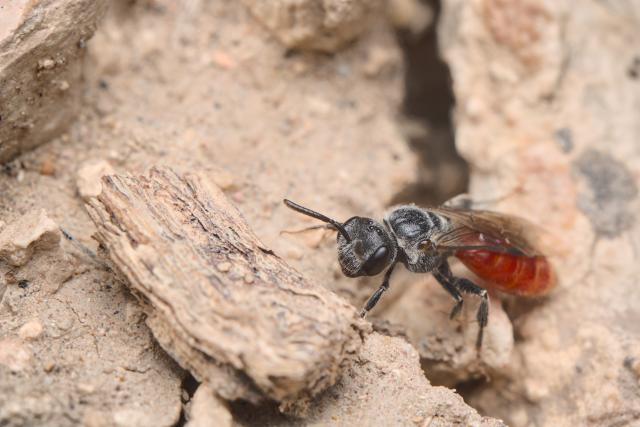
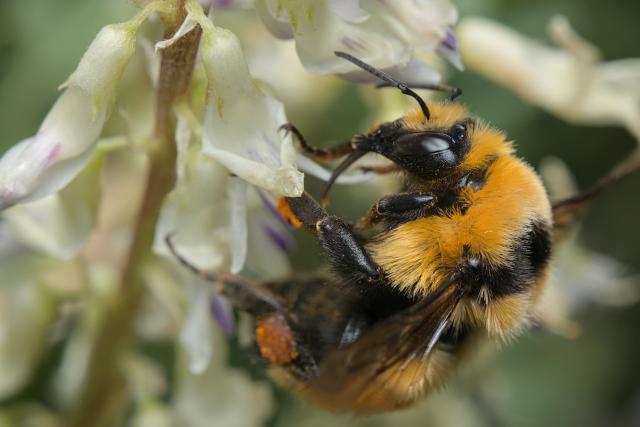
When most people think “bee”, they think “honey bee”. I can’t exactly blame them when they support a tasty, multi-billion-dollar industry. Honey bees, however, are only one non-native species out of the nearly 4,000 native species of bees in North America. Of those species, approximately 80% are ground nesting bees that lead entirely different lives compared to better-known social species, like honey bees and bumble bees. Because ground nesting bees make up the majority of bee species, understanding their ecology is vital to making informed management decisions in the face of sweeping pollinator declines.
The Project: Elk and Bees
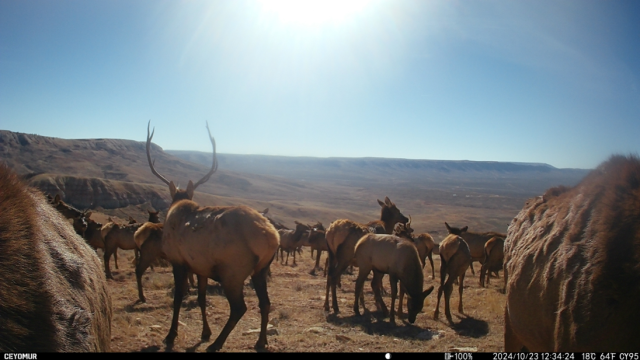
Soil quality is of great importance for ground nesting bees to establish nests and overwinter successfully. All ground nesting bees must dig a nest, provision it with pollen, and lay an egg that will develop over fall, hibernate over winter, and finish development before emerging the following spring. Prior research has shown that soil compaction can modify the bee community by changing which species can dig nests or, at extreme levels, prevent nesting entirely. Some research has measured a positive relationship between soil compaction and cattle stocking density which changed the bee community. Combined with the fact that cattle change vegetation density and floral diversity, it is easy to see how large grazing animals may play an important role in determining the nesting and floral resources available to bees. No studies, however, have investigated this relationship in large ungulates, such as elk. At Fossil Butte National Monument, the West Green River elk herd migrates through the park annually. A previous study found that during hunting season, elk congregate in the park to avoid surrounding public land where hunting is permitted. This creates the opportunity to investigate how the uniquely high intensity of trampling and grazing activity of elk in the park affects nesting resources, floral resources, and overall bee diversity. In doing so, we will expand our knowledge of the ecology of ground nesting bees while providing valuable insights to park management at Fossil Butte National Monument.
Expanding the Research on Public Lands
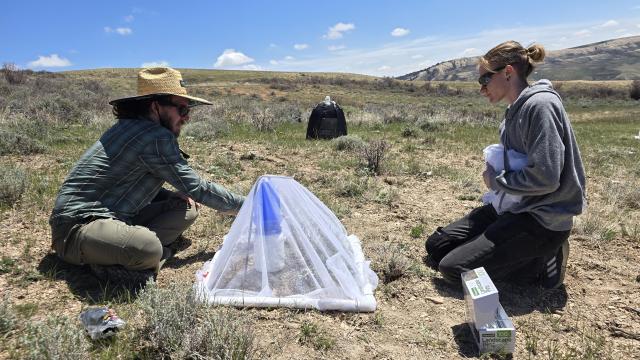
This summer, University of Wyoming Ph.D. student Walker Bensch, affiliated with the Wyoming Natural Diversity Database and the University of Wyoming Department of Zoology and Physiology, will expand his pollinator research onto Bureau of Land Management-administered public lands near Fossil Butte National Monument. Working alongside one to two field technicians, Bensch will collect data throughout the summer to better understand how ungulate behavior may influence ground-nesting bees, flowering plants and pollinator habitat.
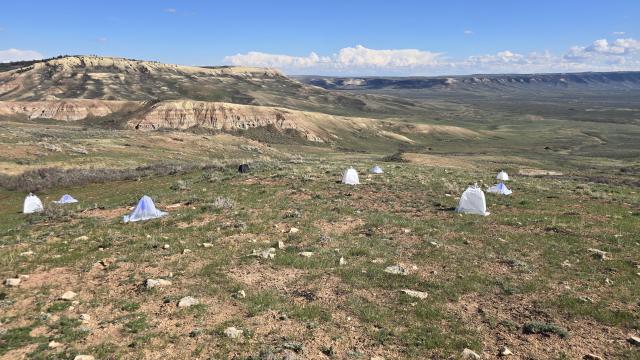
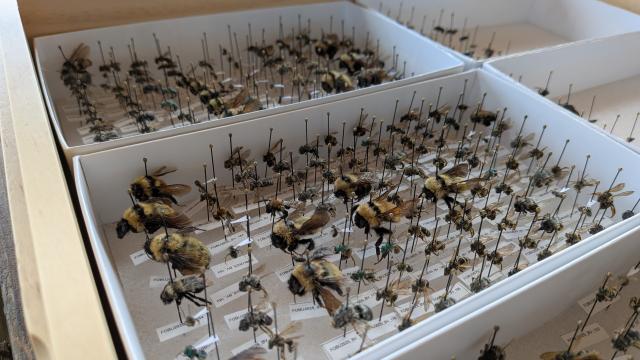
Visitors to the area may notice small white pollinator traps that resemble miniature tents placed at research sites. These temporary monitoring tools help researchers document bee activity and diversity across the study area. Information gathered through the project will contribute to ongoing research on pollinator ecology in Wyoming's sagebrush-steppe ecosystem and improve understanding of how land-use activities affect native pollinator communities.
Increasing Scope through Collaboration: Cattle, Bees, and the BLM
This year I have the privilege to work with the BLM’s Kemmerer Field Office to establish new sites for my summer field season on BLM land surrounding Fossil Butte National Monument. Through this cooperation, my research will more effectively assess the relationship between elk and bees by collecting data from an even broader range of elk activity. In addition to improving my existing research, working with the BLM will give me the opportunity to ask new questions. I expect cattle grazing intensity to vary across sites on public land just as elk grazing does in Fossil Butte. This allows me to investigate the relationship between cattle and the bee community and compare it to elk. While previous research has examined the effects of cattle grazing on bee communities in other parts of the United States, my study will be the first to investigate those relationships in Wyoming's sagebrush-steppe ecosystem.
Related Stories
- Swainson’s Hawks: a remarkable return to California’s Central Valley
- National Public Lands Day Paddles, Plants and Caves: BLM Connects Milwaukee Youth with the Outdoors
- National Public Lands Day Volunteers Revitalize Dean S. Reservoir in Montana
- Celebrating 30 Years of California Condor Recovery at Vermilion Cliffs National Monument
- Using Beavers as Partners in Riparian Habitat Restoration in Las Cienegas National Conservation Area
Office
430 North Highway 189
Kemmerer, WY 83101-9711
United States