


Science in action: A forester’s role in sustaining public lands
Science, data, and hands-on fieldwork guide nearly every decision Maureen Hartshorn makes as a forester with the Bureau of Land Management’s Rawlins Field Office. For more than 14 years, Hartshorn has applied those tools to help manage and restore public lands across Wyoming, supporting forest health, ecosystem resilience, and multiple-use management.
Hartshorn’s role is highly dynamic, blending office-based responsibilities such as data analysis, National Environmental Policy Act work, and contract management with extensive fieldwork. Her days can include forest inventory, timber sale preparation, forest health assessments, planting, cone collection, and contract administration—each task rooted in scientific principles and technical expertise.
“Forestry represents the intersection of multiple-use management and ecosystem restoration,” Hartshorn said. “Balancing the mission to sustain forest health and productivity while supporting a sustainable yield for local and national economies requires careful planning and resource management. My work ensures that forest lands remain resilient and functional for public benefit.”
That balance is reflected in projects she is especially proud of. The first is a limber pine planting project, which marked the first recorded tree planting effort in the Rawlins Field Office. Limber pine, a five-needle pine classified as a BLM sensitive species, was the focus of a restoration effort following wildfire. Cones were collected from healthy, disease-free trees in the unburned portions of the mountain and grown in a nursery for two years, producing 1,500 plugs—compact seedlings with well-developed root systems. With the help of volunteers, all seedlings were planted in a burn scar to support long-term forest recovery.

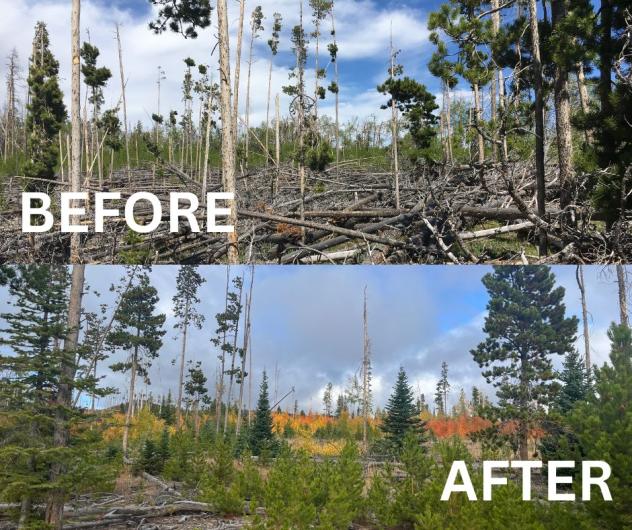
Another significant project is the Teddy Creek Salvage timber sale, one of the first conducted by the Rawlins Field Office in more than 15 years. The area experienced severe mountain pine beetle impacts, with approximately 80 percent tree mortality. From project development through implementation, Hartshorn helped guide the effort and continues to observe successful regeneration and the return of a healthier forest following the harvest.
A core component of Hartshorn’s work is forest mensuration—the science of measuring and analyzing tree and stand characteristics such as volume, age, and growth. This data forms the foundation for forest management decisions, timber valuation, and the development of silvicultural strategies. These strategies guide forest management practices like planting, thinning, prescribed burning and harvesting. All aimed at maintaining healthy, resilient forests.
Hartshorn’s path into forestry began after high school, when she joined the Minnesota Conservation Corps and worked on a variety of natural resource projects. That experience sparked a passion for forestry and led her to pursue a degree in the field, guided by influential professors who helped shape her career.

She encourages young women interested in science-based careers that support public lands to stay the course. “It is the most challenging and rewarding job. While the obstacles can be significant, the opportunity to make even a small positive impact is profoundly satisfying. Keep your head up and work hard—you make a difference."
“I feel like I have the best job in the BLM. I consider myself fortunate to have a role that allows me to manage public lands for long-term health and sustainability,” Hartshorn said. “The work I do today helps ensure that future generations—including my own children—can enjoy thriving, healthy forests.”
Through science-based management and a commitment to stewardship, Hartshorn’s work supports the Bureau of Land Management’s mission to sustain the health, diversity, and productivity of public lands for the use and enjoyment of present and future generations.

Related Stories
Office
1300 North Third
PO Box 2407
Rawlins, WY 82301-2407
United States