


Cold Snap Provides Critical Opportunity for Invasive Species Management at Jupiter Inlet Lighthouse ONA
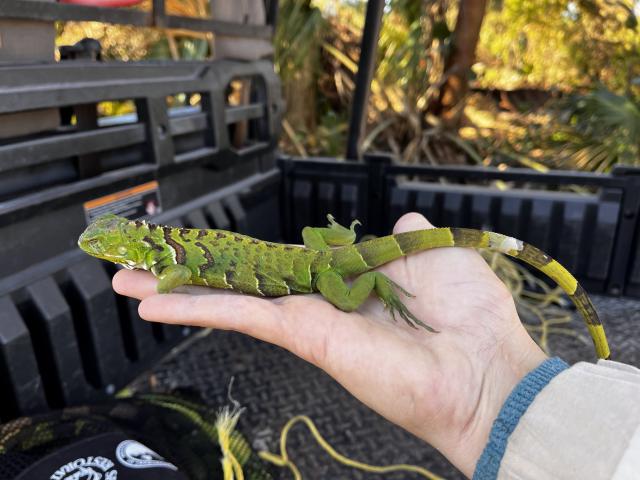
Most people have heard the phrase “it’s raining cats and dogs,” however, how about falling iguanas? Early February brought a rare cold front and freezing temperatures to Jupiter, Florida, home to the Jupiter Inlet Lighthouse Outstanding Natural Area. While these temperatures were unusually cold and posed a challenge for local flora and fauna, they also provided a strategic window for BLM to address the persistent issue of on-site invasive Green Iguanas (Iguana iguana).
The Threat to Infrastructure and Ecosystems
Green iguanas are a significant invasive threat in Florida. Beyond their competition with native wildlife, their behavioral patterns cause substantial damage to public infrastructure. Of particular concern to the BLM, is their tendency to burrow into embankments and shorelines. These extensive tunnel systems lead to the destabilization of the shoreline, increasing erosion and threatening the structural integrity of the historic and natural landscapes we are charged with protecting at the ONA.
A Successful Multi-Day Recovery Effort
Taking advantage of the "cold-stunned" state of the reptiles—a physiological reaction where the lizards become immobile in temperatures below 50°F—the ONA staff conducted thorough sweeps of the ONA grounds. Over the course of the two-day effort, the team successfully collected a total of 24 cold-stunned iguanas.
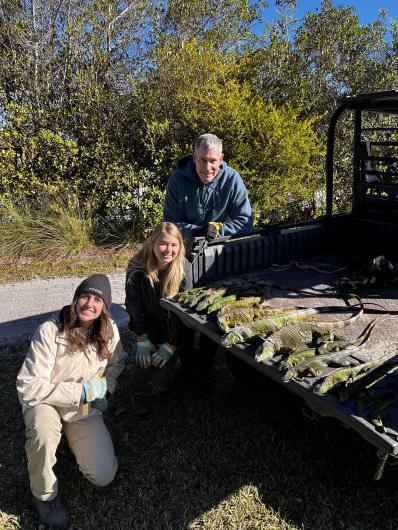
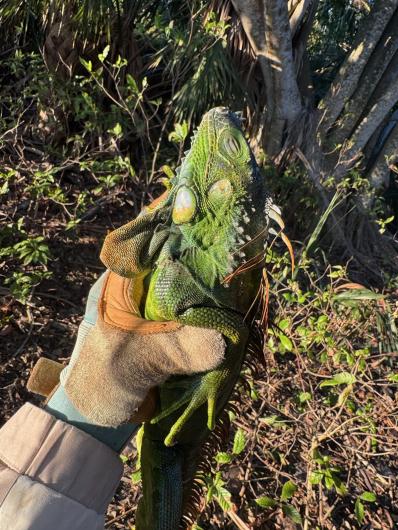
While the mission was serious, the unique nature of the work was not lost on the crew. Intern Sky noted the physical hazards of working under the canopy during a Florida freeze. "It turns out the stories are true—they really do just fall right out of the trees when it gets this cold," she remarked. "This unusual weather event presented us with a vital management opportunity," said Peter De Witt, Program Manager for the Jupiter Inlet Lighthouse ONA. "Removing nearly two dozen mature individuals in a single weekend is a significant win for our local ecosystem. It is imperative that we take every available step to control these invasive populations to protect the stability of our shorelines and the integrity of the ONA."
Humane Disposal and Partnership
In coordination with state efforts, the collected iguanas were transported to designated drop-off locations established by the Florida Fish and Wildlife Conservation Commission (FWC) where they ensure humane disposal or transfer to permitted pet operators. The BLM remains committed to the long-term restoration of native habitats and the mitigation of invasive species impacts.
Related Stories
- BLM recruits future workforce at Missouri University of Science and Technology career fair
- Fossils, furs and a few sparks at Kemmerer Outdoor Discovery Day
- One Mile Closer
- Celebrating National Public Lands Day across the High Desert District in Wyoming
- September Lease Sale Energizes BLM’s Mission and Our Teams
Office
273 Market Street
Flowood, MS 39232
United States