


Using science to uncover mysteries of the Mesa archaeological site in Alaska
North of the Arctic Circle, a solitary mesa rises abruptly from the Alaskan landscape just outside the National Petroleum Reserve. If you stood at the top today, you’d get an unobstructed, 360-degree view of the surrounding treeless tundra. Between roughly 11,700 and 13,600 years ago, Indigenous Inupiaq hunters found this same view useful for spotting Ice Age mammals – steppe bison, musk ox, and caribou – that roamed the landscape below.
The people who occupied the mesa were some of North America’s early inhabitants, and they left behind thousands of artifacts and important features that tell a story about past activities at the site. These include stone projectile points that were probably mounted on lance-like spears and the remnants of 40 ancient campfires, referred to as "hearths" by archaeologists.
Bureau of Land Management archaeologists discovered these artifacts in 1978 when they were surveying public lands here prior to oil exploration. Today, the artifacts reside at the University of Alaska Museum of the North in Fairbanks.
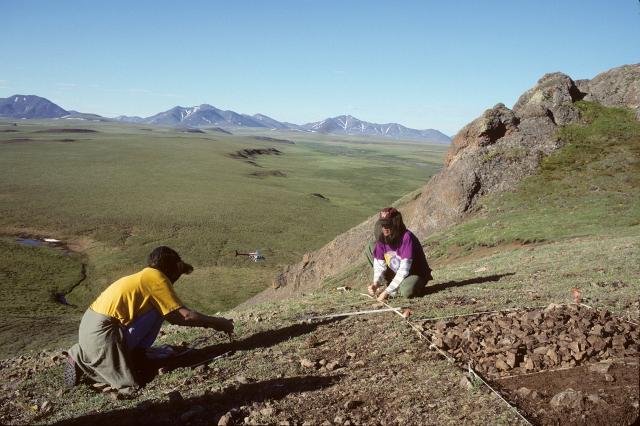
Prior excavation and ongoing interpretation of archaeological resources at the Mesa site showcase the BLM’s multiple-use land management mission in action. For example, the BLM collaborates with Indigenous peoples to ensure respectful co-stewardship while managing public lands for multiple uses, such as energy development in the adjacent National Petroleum Reserve in Alaska. In addition, new scientific findings at cultural sites deepen the public’s connections to the land they call home – where rich history and tradition bring these landscapes to life.
Joe Keeney, archaeologist for the BLM Alaska Arctic District Office, elaborates on the findings at the Mesa site. According to Keeney, the hearths here contained charcoal, which being organic, can be radiocarbon dated.
“Being recovered from the same ancient layer of sediment, the hearths and stone points were found in the same context, so the stone points can be dated indirectly using the dated charcoal in the hearths,” explains Keeney.
Using accelerator mass spectrometry, which allows accurate and reliable dating, archaeologists determined that some of the artifacts from the Mesa site were nearly 12,000 years old, making the site among some of the oldest known archaeological sites in Alaska.
Fast forward to present day, and scientific technology is working to uncover new clues about the lifestyles of the people who occupied the mesa.
Stormy Fields, a scientist at the Alaska Stable Isotope Facility at the University of Alaska Fairbanks, has questions about the people who occupied the site that she is hoping her research will answer. Fields is conducting a process called stable isotope analysis on the hearth sediments.
"While we know that the Mesa people most likely used the site to look for large game millennia ago, there is potential for modern scientific technologies to shed additional light on their lifestyle from the ancient hearth features they left behind," said Fields.
Fields explained that most of the radiocarbon dates from the hearths overlap with the relatively cold, dry time called the Younger Dryas (~11,000-10,000 years Before Present), a time which included a rapid shift in the climate that could have had an impact on available animal populations.
During this time period, people farther south of the Mesa site in interior Alaska were increasing their diet breadth to include freshwater and anadromous fish. Because the Mesa site overlooks the Iteriak Creek, which is large enough to contain freshwater fish, Fields is curious if, like their neighbors to the south, the Mesa people were also fishing during the Younger Dryas—or if they were only hunting large mammals.
“If freshwater or anadromous fish are present at the Mesa site, this will help archaeologists understand more about fish utilization at the end of the last Ice Age,” said Fields.
The Mesa site is unusual because it has so many hearths located together in one spot, Fields noted, and the chemical signatures of the remains of organic materials are preserved well in them. Through scientific analysis, Fields said she can “see” what was burned in these hearths millennia ago by looking at their chemical composition.
Fields explained how it works. A mass spectrometer measures stable isotopes of carbon and nitrogen (which don’t decay over time) by vaporizing small amounts of sample to determine their chemical composition. Through this process, Fields can tell if people burned aquatic resources, such as fish in these hearths.
Fields noted science is becoming more advanced, and that “something like sediments from a hearth, which would have potentially been disregarded in the past, have the potential to tell us a lot about what is going on at an archaeological site.”
“Regardless of what the hearths contain, we will have some cool, new information about a really important Alaskan archaeological site,” said Fields.
As western scientific technology uncovers new clues about the lives of Indigenous people millennia ago, it works in tandem with the long-term, intimate knowledge of place and Indigenous Knowledge carried by the Inupiaq people who continue to live and thrive on these landscapes today. The knowledge, voices and perspectives of Indigenous people play an important role in informing land management.
“The BLM takes this responsibility seriously, understanding that some of these archaeological sites go beyond our contemporary history,” said Donna Bach, BLM Alaska Tribal Liaison. “They are living records of scientific research central to Indigenous identity, sovereignty, and stewardship in Alaska’s North Slope and beyond, validating the continued relationship Indigenous people have with the natural resources they have depended on for millennia.”
At the same time, Bach says that modern scientific technology—such as the research conducted at the Mesa site—can be used to inform the BLM’s work.
“New, innovative scientific technologies can benefit our cultural program staff when they are conducting archeological surveys in the field,” said Bach.
Partnership and collaboration are integral to the BLM’s land management mission, and in Alaska, that means working with Alaska Native Tribes, Native Corporations, and other Indigenous groups. That partnership is especially important in Alaska, which is home to 229 federally recognized Tribes—the most of any state.
As we look to the future of archeological sites like the Mesa site, innovative scientific research will continue to inform the BLM’s work, as the agency strives for that balance between western scientific knowledge and the intimate, place-based knowledge of Indigenous people across our shared American landscapes.
Editor’s note: According to Stormy Fields, the data for her research at the Mesa site has been collected, and the next step is to analyze it; the results should be ready in the next few months.
References
Kunz, M. Bever, M. Adkins, C. (2003) The Mesa Site: Paleoindians above the Arctic Circle. BLM-Alaska Open File Report 86.
Potter, B. A., Halffman, C. M., McKinney, H. J., Reuther, J. D., Finney, B. P., Lanoë, F. B., ... & Kemp, B. M. (2023). Freshwater and anadromous fishing in Ice Age Beringia. Science Advances, 9(22), eadg6802.
Related Stories
- Fossils, furs and a few sparks at Kemmerer Outdoor Discovery Day
- It’s a Hard Rock Life for Buffalo FO Archeological Project Volunteers
- Local Paleoartist Captures BLM Dinosaur Death Struggle
- Volunteers and Partners Retrace 250 Years of History on the Anza Trail
- Framed for Freedom: Bureau of Land Management Eastern States and the Legacy of National Historic Trails