


Pryor Mountains Wild Horse Range
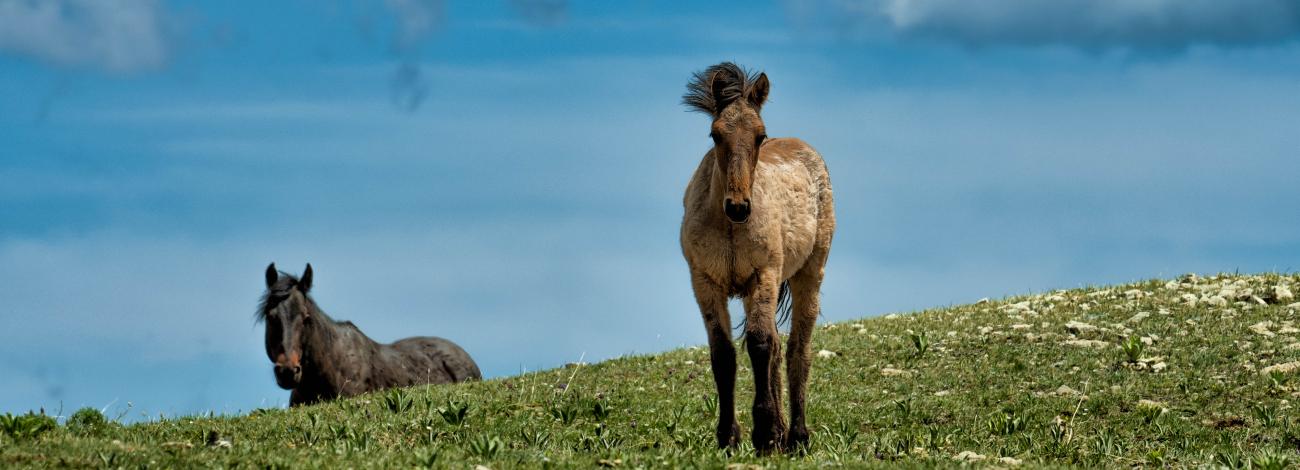
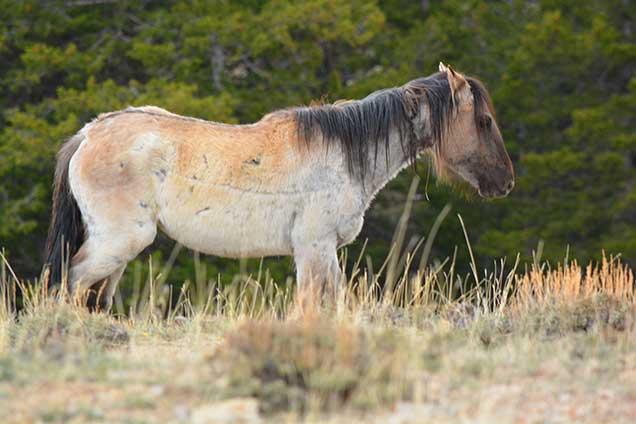
Wild horses in the Pryor Mountain Wild Horse Range include a wide variety of colors, such as bay, black, dun, grulla, roam, buckskin and palomino. The wild horse may have dorsal stripes down the back, bi-colored manes and tails, tiger-striped legs and some may have cobwebbing on the face. Adults typically range in size from 13 to 14 hands.
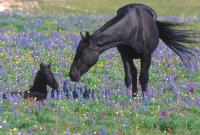
The wild free-roaming horses inhabiting the Pryor Mountain Wild Horse Range most likely descend from a mixture of many domestic breeds. Recent genetic tests concluded that Pryor horses include a higher than average level of ancestry from New World “Spanish” breeds (saddle type horses) and related to European “Spanish” breeds, in addition to other "light racing and riding breeds." Other genetic analyses suggested that the single closest breed to Pryor horses was the Quarter Horse. Some of the Pryor horses carry a rare allele variant Qac that has been traced back to the original New World “Spanish” type horses – Spanish and Portuguese (Iberian) horses that were brought to the Americas. However, all of the genetic markers in these wild horses are found in other horse breeds.
The Pryor Mountain Wild Horse Range is one of only four designated wild horse and burro ranges in the country, which means the area is managed principally, but not exclusively, for wild horses and burros. The Pryor Mountain Wild Horse Range was created by order of the Secretary of the Interior, Stewart L. Udall on September 9, 1968. At the time, the Pryor Mountain Wild Horse Range encompassed 33,600 acres of BLM and National Park Service-managed lands in Montana. In the years since, additional land was added to the Range, including land across state lines in Wyoming. Today, the Pryor Mountain Wild Horse Range comprises of more than 38,000 acres.
Location: The Pryor Mountain Wild Horse Range is in the southeastern portion of Carbon County, Montana, and northern Big Horn County, Wyoming. Approximately 50 miles south of Billings, Montana, and 10 miles north of Lovell Wyoming. Every year, many visitors come to the public lands to enjoy observing these well-known wild horses from a safe distance.
Topography/Vegetation: The area is high in diversity and complex in nature. Elevations range from 3,850 feet to 8,750 feet above sea level. Annual precipitation varies with elevation from 6 inches of precipitation in the lower elevations to upwards of 20 inches in the alpine high elevation. Soils vary in depth from shallow (less than ten inches) to 20-40 inches deep depending on site locations and position on the landscape. Water is considered a limited resource within the Pryor Mountain Wild Horse Range.
Habitat within the Pryor Mountain Wild Horse Range is diverse and ranges from shrub-grass vegetation including big sagebrush, Gardner’s saltbush, black sagebrush, rhizomatous wheatgrasses, Indian ricegrass, needle and thread and bluebunch wheatgrass to communities that include Douglas-fir, lodgepole pine, subalpine fir, limber pine, and juniper.
Plant communities also vary with elevation and precipitation from cold desert shrub to sub-alpine forests and meadows.
Pryor Mountain Herd Management Area Plan Frequently Asked Questions
- Who manages the Pryor Mountain Wild Horse Herd?
The BLM and U.S. Forest Service jointly manage the Pryor Mountain Wild Horse Range (PMWHR).
- Are the Pryor Mountain horses truly “Spanish mustangs”?
The Pryor Mountain horses carry measurable Spanish genetic influence, but they are a herd of mixed ancestry. The BLM’s management plan maintains characteristics “typical of Pryor Mountain horses of mixed ancestry, including Colonial Spanish.”
- How many horses live on the Pryor Mountain Wild Horse Range?
As of spring 2024, the estimated population is 200 horses aged one year and older. This is approximately 65 percent above the upper Appropriate Management Level of 120 horses.
- Where exactly is the Pryor Mountain Wild Horse Range?
The PMWHR covers approximately 39,994 acres in the southeastern portion of Carbon County, Montana, and northern Big Horn County, Wyoming. It straddles the Montana-Wyoming border, sits about 50 miles south of Billings, Montana, and 10 miles north of Lovell, Wyoming.
The range spans dramatically different environments from high-desert salt-shrub terrain at roughly 3,850 feet in the Wyoming portion to subalpine meadows near 8,750 feet in the northern Montana section. The BLM administers about 27,114 of those acres; the remainder is managed by the National Park Service (Bighorn Canyon National Recreation Area), the U.S. Forest Service (Custer Gallatin National Forest), and private landholders.
- What was decided in the 2026 Pryor Mountain Joint Herd Management Area Plan?
In June 2026, the BLM Billings Field Office issued a Decision Record selecting Alternative 2 (the Proposed Action) from the Environmental Assessment. The decision covers two primary components:
A new Joint HMAP establishing updated objectives for managing the wild horse population, rangelands, and riparian areas.
A revised Appropriate Management Level (AML) of 107 to 120 horses, up from a lower limit of 90 under the previous 2009 HMAP.
A separate decision on the wild horse gather plan is expected to be issued at a later date. The BLM anticipates the first gather will occur in fiscal year 2027.
- Why is the BLM taking this action now?
BLM is required by the Wild Free-Roaming Horses and Burros Act of 1971 to manage wild horse populations to achieve and maintain a “thriving natural ecological balance” (TNEB) on the range. The agency is also under a court mandate stemming from Kathrens v. Zinke (2018) to re-evaluate the AML using the methodology outlined in the BLM Wild Horse and Burro Handbook.
A 2021 rangeland health assessment found that the PMWHR is not meeting land health standards in three areas: upland health, riparian/wetland health, and habitat for native plants and animals, primarily because the horse population has been above AML for most of the past 50 years.
- What is an Appropriate Management Level, and how was it calculated?
The Appropriate Management Level (AML) is the population range within which wild horses can be managed while maintaining a thriving natural ecological balance. The upper AML is the maximum number of horses the range can support without causing deterioration. The lower AML is set so the population can grow naturally to the upper AML over four to five years without additional gathers.
BLM calculated the new AML of 107–120 horses through a three-tier process: evaluating whether essential habitat components (forage, water, cover, and space) are sufficient; calculating sustainable forage availability; and confirming the projected population is sufficient to maintain genetic diversity. The lower limit increased from 90 to 107 based on observed population growth rates during periods when fertility control was administered but gathers were not conducted.
- What alternatives were considered, and why wasn’t another alternative selected?
Four alternatives were analyzed in the Environmental Assessment:
Alternative 1 — Continue 2009 HMAP management with RMP amendment. Rejected because it would maintain horses above AML, would not make progress toward rangeland health standards, and would likely accelerate loss of genetic diversity by targeting non-Spanish phenotypes for removal.
Alternative 2 (Selected) — New HMAP with revised AML, random age- and sex-based removal criteria, and expanded fertility control options.
Alternative 3 — Lineage-based removal decisions using matrilineal data. Rejected because lineage data for paternity was confirmed accurate in only 72.5 percent of cases, making it unreliable as a broad removal strategy; targeting specific named horses through bait trapping would also be impractical.
Alternative 4 (No Action) — No gather, fertility control only. Rejected because it would allow the population to grow to an estimated 291 horses in 10 years, further degrading the range and potentially triggering a population crash.
- When will horses be gathered, and how many will be removed?
BLM anticipates issuing a separate gather decision and conducting the first gather in 2027. The initial gather is designed to reduce the population from approximately 200 to about 150 horses. Subsequent gathers will continue as expeditiously as possible until the population reaches the lower AML of 107 horses. Once lower AML is achieved, a new excess determination will be required before any additional gathers to maintain population within AML.
- How will horses be gathered?
The primary gather method will be bait and water trapping that uses food or water to draw horses into temporary holding enclosures. BLM will use helicopter gathers only in emergency situations where horses must be removed quickly or bait trapping proves ineffective. All gather operations will be conducted in accordance with BLM’s Comprehensive Animal Welfare Program. A licensed veterinarian will be on-site or on call throughout the gather to examine animals and advise on care and treatment.
- Which horses will be removed?
Under the selected alternative, horses will be selected for removal based on the following criteria, in order:
Any horse with a genetic defect (hernias, parrot mouth, dwarfism, clubfoot, contracted tendons).
Any horse resulting from a closely inbred pairing (father/daughter, mother/son, full or half siblings).
Remaining horses removed to meet desired age class and sex ratio targets, with preference given to younger horses (ages 1–4 first, then 5–10).
No horses 20 years of age or older will be removed in planned gathers.
Color is considered last, but the BLM will attempt to maintain variety in colors on the range.
- What happens to gathered horses?
Removed horses will be transported to the Britton Springs administrative site or another holding facility, where they will be prepared for adoption, sale, or placement in off-range pastures. Since 1971, BLM has removed 668 horses from the PMWHR across 26 gathers, and every horse removed has been placed. The Pryor horses are particularly sought after by the public due to their distinctive appearance and well-documented lineages.
- Will removing horses harm the genetic diversity of the herd?
Based on scientific modeling completed by the USGS, the answer is no — at least not over the 10-year life of this management plan, and likely not for the next 100 years. The USGS ran 1,000 simulations under four different removal strategies and found that all scenarios maintained the key genetic diversity threshold (observed heterozygosity above 0.66) throughout the plan period.
BLM will continue to monitor observed heterozygosity through fecal DNA sampling and hair follicle collection during gathers. If diversity drops below established thresholds, BLM can take corrective actions including adjusting sex ratios, increasing the number of breeding-age horses, or introducing horses from genetically compatible herds.
- Will BLM bring in horses from other herds?
Not immediately. The current observed heterozygosity (0.731 as of 2021) is above management thresholds, and modeling suggests it will remain there for the foreseeable future. Introductions are held in reserve. If monitoring shows genetic diversity is declining toward critical levels, BLM may introduce horses from herds with similar characteristics — such as the Sulfur herd in Utah or the Cerbat Mountain herd in Arizona.
- What about the bloodlines and lineages advocates have tracked for decades?
BLM considered a lineage-based removal approach as Alternative 3, developed specifically in response to public comments. It was ultimately not selected because paternity data was confirmed accurate by DNA testing in only 72.5 percent of cases, making it insufficiently reliable for broad removal decisions.
The selected approach does not target specific bloodlines for removal. Genetic material from named lineages is carried not only by direct offspring but by cousins, half-siblings, and more distant relatives throughout the herd, meaning no specific line is eliminated simply because one individual is removed.
- How is the range doing currently?
The range is in a degraded condition. A 2021 Rangeland Health Assessment found the PMWHR is not meeting three land health standards:
Standard 1 (Upland Health): Not met. Overpopulation has shifted plant communities from tall, productive cool-season grasses to short, less nutritious species. High bare-ground exposure, soil terracetting, and erosion are documented across the range.
Standard 2 (Riparian Health): Not met at Cottonwood Spring, which is rated Functioning at Risk due to overuse by horses and high soil salinity.
Standard 5 (Native Plant and Animal Habitat): Not met. The Pryor Mountains Bladderpod, a BLM sensitive plant species found only in this area, has experienced significant trampling-related habitat loss at the Sykes Ridge population site.
The causal factor identified in all three cases is the overpopulation of wild horses.
- What will happen to the range if no horses are removed?
Under the No Action alternative, modeling projects the herd would grow to approximately 291 horses within 10 years. Rangeland conditions would continue to decline across all elevations. Cool-season bunchgrasses, which are the highest-quality forage, would likely disappear from some areas, replaced by less productive species. Erosion and bare ground would worsen. Eventually, the range’s ability to support healthy horses could collapse, potentially requiring an emergency gather or resulting in widespread mortality.
- What riparian improvements are planned?
The selected alternative includes restoration work at two water sources:
Cottonwood Spring: BLM will remove nonfunctional water infrastructure, temporarily close the spring to horses, construct Beaver Dam Analogs to improve water retention and flush accumulated soil salts, and remove invasive salt cedar and Russian olive. Monitoring will determine whether fencing remains necessary or whether an off-site solar-powered trough is needed.
Sykes Spring: BLM will treat spotted knapweed, reseed native species, redesign the spring infrastructure to provide more reliable water, and install Zuni bowls to prevent further erosion near the spring enclosure.
- What fertility control is currently used, and will that change?
BLM has administered the ZonaStat-H (PZP) vaccine to Pryor Mountain mares by remote dart since 2001. PZP is approximately 90 percent effective for mares treated twice in the first year, but some mares are non-responders and continue to produce foals.
Under the selected alternative, ZonaStat-H remains the preferred method, but BLM may now also use GonaCon-Equine or other approved immunocontraceptives for non-responders. Mares 18 months to 3 years old will be primed and treated. Mares four years and older will come off treatment until after they have successfully raised one foal to one year of age, then return to treatment. This approach gives each mare the opportunity to contribute genetically while still allowing BLM to manage population growth.
- How much public input did BLM receive?
Public engagement on this project spanned several years and generated substantial comment. BLM received over 1,300 comments during the initial 2020 scoping period, more than 13,500 comments on the preliminary EA in 2023, and additional comments on the proposed RMP amendment in 2022. Alternative 3 was developed directly in response to public comments requesting a lineage-based removal approach. Several notable revisions to the final EA, including clearer age class and sex ratio language and an expanded cultural resources analysis, also resulted from public feedback.
- Were Tribes consulted?
Yes. BLM sent consultation letters to 18 Tribal Nations with ancestral ties to the region. The Crow Tribe, Northern Cheyenne Tribe, and Gros Ventre and Assiniboine Tribes engaged most directly. BLM worked with the Crow Tribal Historic Preservation Officer to add a full cultural resources analysis examining the horses’ significance to Crow identity.
Both the Crow and Northern Cheyenne Tribes expressed concern about the current degraded range conditions and the availability of sacred plants on the landscape. No Tribe identified concerns with the selected alternative. The selected alternative is expected to improve rangeland health in ways consistent with Tribal interests.
- Can the public appeal this decision?
Yes. The decision may be appealed to the Interior Board of Land Appeals (IBLA) within 30 days of receiving notice of the decision. A petition for a stay may also be filed. Contact the BLM Billings Field Office for procedural guidance.
- Where can I learn more or find the full documents?
The full Environmental Assessment, Finding of No Significant Impact, and Decision Record are available through the BLM’s National NEPA Register.
Pryor Mountains Wild Horse Range HMA Map
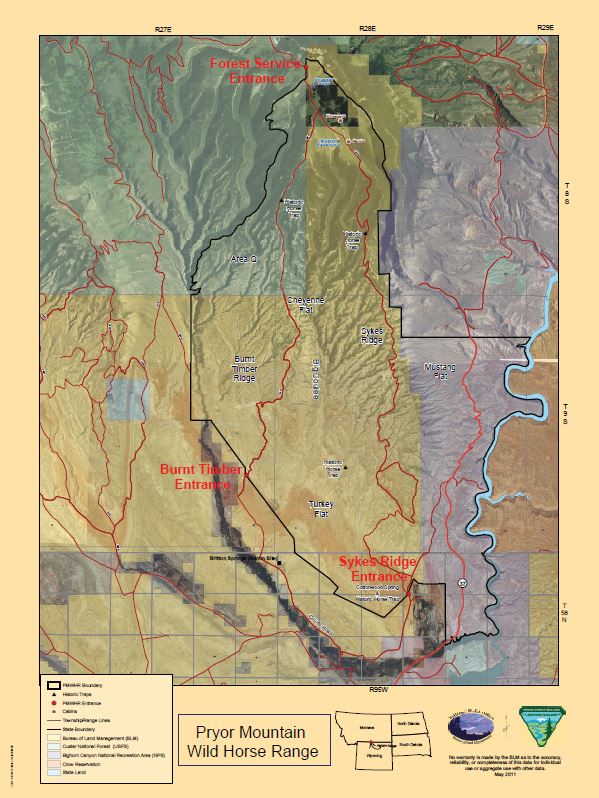
Download a PDF of the Pryor Mountains Wild Horse Range Herd Management Area Map