


BLM Approves Plan Addressing Overpopulation in Red Desert Complex Herd Management Area
Organization:
Media Contact:
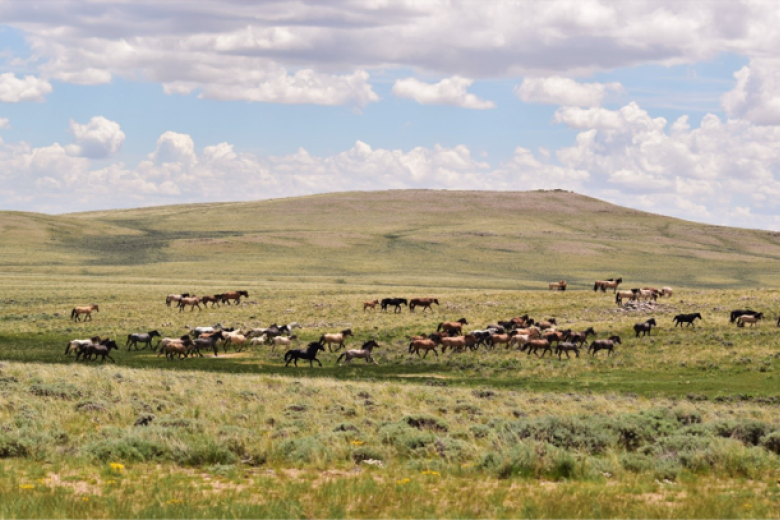
LANDER, Wyo. – The Bureau of Land Management has approved a plan to address significant wild horse overpopulation and protect rangeland health within the Antelope Hills, Crooks Mountain, Green Mountain, Lost Creek and Stewart Creek herd management areas. This plan aligns management actions on the range to alleviate wild horse suffering from overpopulation, which leads to overgrazing and a lack of water, with national program goals to protect rangeland health.
Without active management, herds continue to grow unchecked and can double in size every four to five years. Chronic overpopulation places both horses and rangeland resources at risk. When wild horse herds exceed the appropriate management levels, forage and water become scarce, leading animals to move outside of herd management area boundaries that cause safety risks and damage to private property. Overpopulation also increases the likelihood of horses experiencing starvation, thirst or injuries as they search for limited resources. This pattern results in habitat degradation, reduced forage availability for other wildlife and long-term resource damage.
Recent infrared aerial surveys of the Red Desert Complex confirm wild horse numbers far exceed the appropriate management level of 480-720 horses. Current population estimates require gather operations to remove about 1,800 horses and return herd sizes to sustainable levels.
To achieve and maintain health of the horses and the landscape, the BLM will use a combination of incremental gathers and ongoing fertility control treatments. Gathers are an essential management tool for preventing long-term impacts to rangelands and protecting the health and safety of wild horses. Gather operations are planned to begin in fall 2026.
Fertility control limits reproduction, helping balance herd numbers and reducing the need for frequent, large-scale removals. During gather operations, staff plan to treat around 75 to 150 mares with fertility control and release them back to the range.
BLM staff and contractors will conduct all gather operations in accordance with the Comprehensive Animal Welfare Program, which outlines science‑based, humane handling requirements designed to safeguard wild horse health and safety. During gather operations, helicopter pilots and ground crews maintain a controlled approach to keep horses together and moving at a safe pace. Horses are not pushed to exhaustion, and special caution is given to compromised animals, such as foals and older animals.
Nationwide, more than 99 percent of wild horses and burros are gathered safely without severe incident. Upon arrival at designated holding facilities, the horses will receive veterinary evaluation and care and will be prepared for placement into private care through the BLM’s Adoption and Sales programs or long-term contracted pastures as appropriate.
The Red Desert Complex encompasses nearly 752,694 acres of mostly BLM-managed public land intermingled with private lands. The complex supports wild horses alongside native wildlife, livestock grazing, and other uses.
The BLM manages and protects wild horses and burros under the Wild Free‑Roaming Horses and Burros Act of 1971. Management decisions are guided by detailed analysis of current conditions and multiple‑use requirements across public lands to ensure thriving ecological balance. Additional information about the Red Desert Complex gather plan, including decision records and the environmental assessment, is available at the BLM National NEPA Register.
The BLM manages about 245 million acres of public land located primarily in 12 western states, including Alaska, on behalf of the American people. The BLM also administers 700 million acres of sub-surface mineral estate throughout the nation. Our mission is to sustain the health, diversity, and productivity of America’s public lands for the use and enjoyment of present and future generations.