


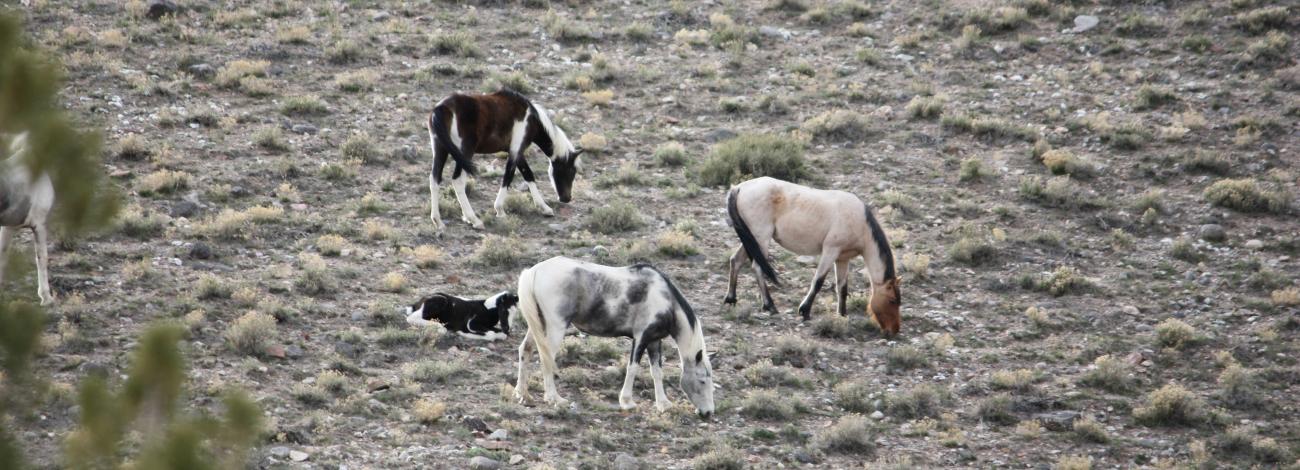
2026 Swasey Wild Horse Gather
Purpose of Gather:
The BLM is conducting gather operations to reduce overpopulation in support of healthy wild horses on healthy public rangelands. With few natural predators, wild horse herds increase 15-20 percent annually, doubling in size every 4-5 years. Without management, herds can quickly outgrow what the available forage and water on the land can support. Constant overpopulation can degrade resources critical for wild horses and other wildlife, and can lead to starvation and thirst for the wild horses themselves, especially during winter and dry summer seasons.
Details of Gather:
The BLM plans to gather and remove approximately 140 excess wild horses from the Swasey Mountains Herd Management Area. The appropriate management level for the Swasey herd is 60-100 wild horses based on the available forage, water and other authorized uses, such as wildlife habitat and livestock grazing.
Under BLM supervision, contractors will conduct gather operations with assistance of one or more helicopters that will guide animals on the range into temporary gather corrals. The careful use of helicopters allows the BLM to safely and efficiently move wild horses across large, rugged landscapes while reducing stress and minimizing risks associated with prolonged pursuit on horseback or land-based vehicles.
The safety and welfare of wild horses during gather operations is a top priority for the BLM. All operations will be conducted in full compliance with the BLM’s Comprehensive Animal Welfare Program.
Public Observation:
The BLM will temporarily close certain public lands around gather locations to public access, including a prohibition on the use of unmanned aerial vehicles ("drones"), in accordance with 43 CFR 8364.1. The closures are necessary to protect the wild horses, as well as public health and safety.
Opportunities are available for the public to observe gather operations through BLM-escorted tours as long as conditions remain safe for both the horses and participants, and gather operations are not disrupted.
What to Expect
Observers should prepare to spend multiple hours at the observation site, in and outside their vehicles, and must provide their own transportation, water, and food. No public restrooms will be available. The BLM recommends weather-appropriate footwear and neutral-colored clothing. No signage, large displays, or colorful equipment that could cause distractions will be allowed. Binoculars, high-zoom photo lenses, and four-wheel-drive, high-clearance vehicles are also strongly recommended.
Reservations
- Daily public observation tours for the Swasey Gather are scheduled to begin Nov. 2, departing from Delta, Utah in the early morning.
- Observation schedules and locations are subject to change based on weather, safety conditions, and operational needs.
- Observation participation is limited to 10 people per day to reduce operational risk and help ensure safe gather operations for both the horses and participants.
- Daily reservations are available on a first-come, first-served basis. In periods of high demand, the BLM will prioritize opportunities for credentialed media and individuals who have not previously observed gather operations during the gather.
- Reservation requests must be received by 5 p.m. Mountain Time on the day before the requested observation date.
- Reservations are available only for the following day's operations. Multiple-day reservations and advance reservations for future dates will not be accepted.
- To request a reservation to observe, leave a message on the Utah Gather Hotline at (801) 539-4050 with the name, phone number, and affiliation (if any) for each person in your party, along with the total number of people and vehicles attending.
- The BLM will contact individuals by text or phone call with confirmed reservations by 8 p.m. Mountain Time and provide meeting location and departure details.
Contact Information
Utah Gather Hotline: (801) 539-4050
For questions about media observation, contact BLM Utah External Affairs.
Adoption Information:
All gathered wild horses will be transported to the Sutherland Off-Range Contract Wild Horse Facility near Delta, Utah, where they will be checked by a veterinarian and readied for the BLM’s wild horse Adoption and Sale Program. Those that are not placed into a new home will be cared for in off-range pastures, where they live off the rest of their lives on grass pastures. Learn more about the BLM’s Adoption and Sale programs.
Background:
The historical origin of wild horses or the source of the animals that occupy the Swasey HMA is unknown. However, many of the horses in the herd are descendants of horses that were turned loose or escaped from local ranches. Historically, the Swasey herd was dominated by gray and light-colored horses, and this trait continues today. Other common colors include black, brown, bays, buckskins, and pintos. The average size of herd adults is 14 to 14 1/2 hands.
Location
The Swasey HMA is located in Juab and Millard counties, in the Swasey Mountains in north-central Millard County, approximately 50 miles west of Delta.
Size
The HMA contains 120,113 acres of public and state lands.
Topography/Vegetation
This range is made up of long, narrow and steep ridges with large flats areas in Whirlwind Valley. Elevation varies from 9600 feet to 4500 feet. Precipitation averages 4-6 inches at lower elevations to 6-8 inches at the highest elevations. Temperatures also vary, from 0 and -10 degrees Fahrenheit in winter to between 100 and 105 degrees Fahrenheit in summer.
Vegetation in the area is made up of three main vegetative types. Saltbush-grass type, black sage-grass type, and rabbit brush-grass type. There are juniper and pinyon pine trees that occur on the mountain ridges. Key species include indian ricegrass, bottlebrush squirreltail, galletta, needle-and-thread, sand dropseed, and winterfat.
Permanent waters are located on the east side of the HMA below Swasey Peak. Several of these waters have been developed and are piped to various portions of the HMA to distribute availability. Horses also water at Coyote Springs which is located on the west side of the HMA in Tule Valley. Water is also available occasionally at several springs on the north end and catchment ponds throughout the HMA after large storm events.
Wildlife
Pronghorn Antelope and Mule Deer reside in the HMA year-round. The antelope mainly use the low elevations; the deer tend to use the higher elevations for most of the year, dropping to lower elevations during the winter. Other wildlife in the area includes rock squirrels, antelope squirrels, chipmunks, lizards, snakes, hawks, and eagles.
Additional Information
For information on how to adopt or purchase a wild horse or burro, visit the Wild Horse and Burro Program page.
Gather Status
The gather is scheduled to begin on Monday, November 2, 2026.