


BLM to Begin Sand Wash Basin Wild Horse Gather to Protect Herd and Rangeland Health
Organization:
BLM Office:
Media Contact:
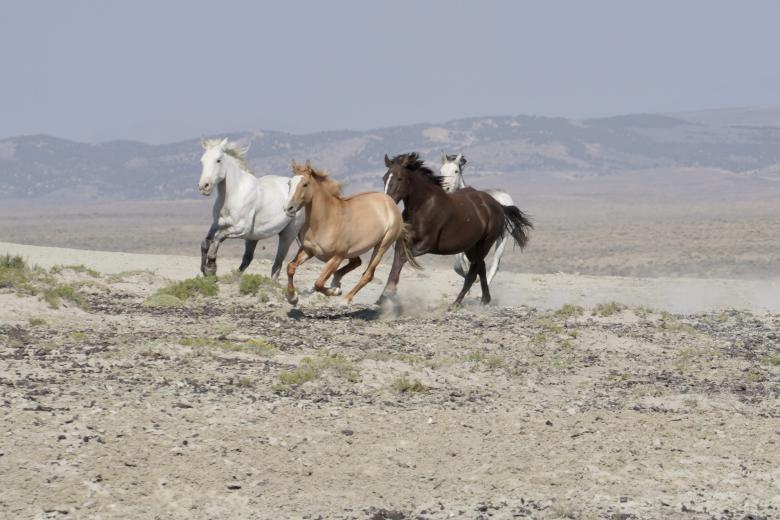
Craig, Colo. — The Bureau of Land Management will begin a wild horse gather Sept. 19 in and around the Sand Wash Basin Herd Management Area in northwest Colorado. The operation is part of ongoing, proactive efforts to reduce overpopulation and maintain a sustainable herd size, safeguarding both wild horse health and the drought‑strained rangelands they rely on.
Without active management, wild horse populations can grow rapidly and may double in size every four to five years. When populations exceed the Appropriate Management Level, forage and water become increasingly scarce. Horses might travel outside the Herd Management Area in search of resources, creating safety concerns and potential conflicts with private property. Overpopulation also increases the risk of horses experiencing starvation, thirst and injuries as they compete for limited forage and water. Continued overpopulation can result in habitat degradation, reduced forage availability for wildlife and livestock, and long-term damage to rangeland resources.
“The purpose of this gather is to help maintain a healthy wild horse population on a healthy landscape,” said BLM Northwest District Deputy Manager James Michels. “This is an important part of our ongoing management of the Sand Wash Basin herd.”
The Sand Wash Basin Herd Management Area can sustainably support 163 to 362 horses. The current total estimated population is 505 horses, which is 140 percent over what the range can sustainably support.
Of the 300 horses planned for gather, about 245 horses will be removed from the range, and 55 will be returned to the Sand Wash Basin Herd Management Area. Fertility control is also an important tool for managing wild horse populations. By limiting reproduction, fertility control helps balance herd numbers and can reduce the need for frequent, large-scale removals. Twenty-two of the returned horses will receive fertility control treatment to help slow future population growth.
BLM staff and contractors will conduct drive-trap gather operations in accordance with the Comprehensive Animal Welfare Program, which establishes science-based, humane handling requirements designed to protect wild horse health and safety. During gather operations, helicopter pilots and ground crews use controlled approaches to keep horses together and moving at a safe pace. Horses are not pushed to exhaustion, and special care is taken with animals that may be more vulnerable, including foals and older horses. Nationwide, more than 99% of wild horses and burros are gathered safely without a severe incident.
Following the gather, removed horses will be transported to the Wheatland Off-Range Corral Facility in Wheatland, Wyoming, where they will receive veterinary care, vaccinations, identification, and evaluation. Horses determined suitable for placement will eventually be made available for adoption or other placement opportunities through the BLM’s Wild Horse and Burro Program.
During the gather, the BLM will temporarily close certain public lands within the Herd Management Area to public access. The public may view the gather on designated days with a BLM escort. Information about viewing opportunities and additional details is available on the Sand Wash Basin gather website.
The gather is expected to take approximately 11 days, although the exact start and end dates will depend on contractor availability, weather, and the safety of the horses and people participating in the gather.
The Sand Wash Basin Herd Management Area is located about 45 miles west of Craig in northwest Colorado and encompasses approximately 157,730 acres of public, state and private lands. The Herd Management Area consists of sagebrush, bunchgrass, saltbush and pinyon-juniper woodlands and supports a variety of wildlife, including elk, mule deer, pronghorn and greater sage-grouse.
The Wild Free-Roaming Horses and Burros Act of 1971 directs the BLM to protect and manage wild horses and burros on public lands while maintaining a thriving natural ecological balance. The BLM manages wild horses as one part of a larger multiple-use mission that includes wildlife habitat, recreation, livestock grazing, and other public land uses.
The BLM’s Wild Horse and Burro Program is grounded in science, law, and humane‑care standards and adheres completely to the Wild Free-Roaming Horses and Burros Act and other federal laws. The BLM does not send wild horses or burros to slaughter, and no loophole exists that would legally allow people who adopt or buy wild horses to ever sell animals directly or to middlemen for slaughter.
Supporting National Environmental Policy Act documents for this gather are available through the BLM’s National NEPA Register. For more information, contact BLM Colorado at BLM_CO_News@blm.gov.
The BLM manages about 245 million acres of public land located primarily in 12 western states, including Alaska, on behalf of the American people. The BLM also administers 700 million acres of sub-surface mineral estate throughout the nation. Our mission is to sustain the health, diversity, and productivity of America’s public lands for the use and enjoyment of present and future generations.