


People and Places of the California Trail
Who traveled and lived along the California Trail, and what were their experiences like? Students explore the perspectives of people at different stages of the journey—from leaving home and seeking new opportunities, to facing harsh environments and encountering Indigenous peoples, to arriving in California and building new lives.
Field Trip Length and Grade Range
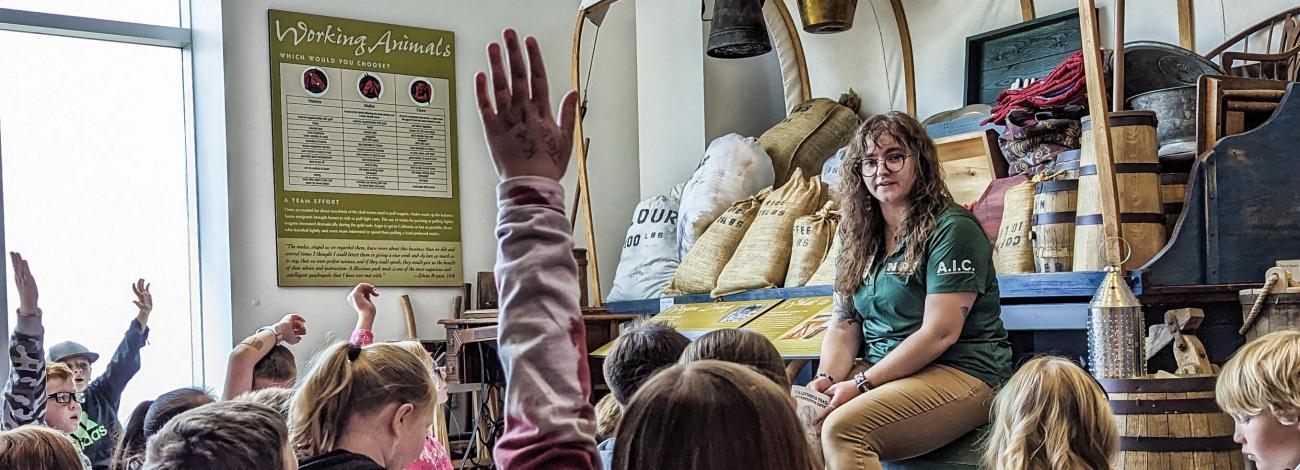
This school field trip is designed for students in grades 4 and 5. The program is 2.5 hours long and can be requested for morning (9:30 am - 12 pm) or afternoon (12:30 - 3 pm). Groups are welcome to extend their visit with a teacher-led picnic lunch or hike.
How to Participate
Visit School Field Trips for program dates and a registration link.
People and Places on the California Trail - Teacher's Guide
Overview
Traveling West invites students to step into the lives of people who traveled, lived, and worked along the California Trail. Working in teams, students explore six locations along the journey, from Missouri to California and the construction of the transcontinental railroad.
Along the way, students look for clues about how people found food, shelter, clothing, and transportation. They also consider what people from different backgrounds might have hoped for and worried about, discovering that the journey west looked different for everyone.
What Students Will Learn
Students will:
- Explore how people met their basic needs along the California Trail.
- Discover the challenges travelers faced on their journey west.
- Learn about Indigenous peoples who had lived on these lands for thousands of years.
- Use evidence to figure out what different people might have hoped for and worried about.
- Compare the experiences of pioneers, Indigenous peoples, Black travelers and workers, Chinese immigrants, and others.
- Discover why people came to California and the different ways they made a living.
- Learn how the transcontinental railroad changed travel across the West.
Vocabulary and Concepts Covered
California Trail — A historic route traveled by thousands of people moving west to California.
Pioneer — A person who moves to a new place, especially as part of settlement.
Wagon train — A group of wagons traveling together.
Indigenous peoples — The original peoples of a place and their descendants.
Immigrant — A person who moves to another country to live.
Gold Rush — A time when many people came to an area hoping to find gold.
Transcontinental Railroad — A railroad connecting the eastern and western United States.
Perspective — The way a person’s experiences shape how they see something.
Evidence — Information that helps us understand the past.
Inference — A conclusion we make using evidence.
Before the Field Trip
- Assign or read aloud the California Trail Overview student reading.
- Optional: Show this 26-minute overview video, "Preserving Gravelly Ford"
- Ask the students to think about the experience of traveling the California Trail. Have them consider the following questions:
- Imagine you’re going on a trip. How will you navigate – maybe by entering the address in an online map? How will you get there – maybe by car or bus? What communication methods will you use along the way – maybe phone calls or text messages? What will you eat – maybe stop at a store or restaurant? Imagine how different this would have been for travelers on the California Trail, who journeyed for at least six months in a time before phones, internet, online maps, or motorized vehicles. What might you consider while preparing for such a difficult journey?
- Imagine you’re going to travel the California Trail. How do you think being a kid would affect your experience? How do you think the experience would be different for your parents, siblings, or grandparents, and why? Who else along the trail might have a different perspective than you, and why?
- Encourage students to think of questions to ask during the field trip.
- Assign wagon teams. Each team will consist of one adult chaperone and six students that will rotate through stations throughout the exhibit area. Carefully consider social dynamics, including whether to assign students to groups for which their guardian is a chaperone.
During the Field Trip
- Materials needed: None! We will provide leader guides with instructions and answers for the adults.
- Teachers and chaperones are responsible for facilitating activities and discussions at the learning stations. This includes fostering engagement with the material and managing student behavior.
- Example Field Trip schedule:
- 9:30: Arrive, use bathrooms, introduction
- 9:45: Station Rotations
- 10:30: Discussion and transition to Hands-on Activities
- 11:45: Conclusion and wrap-up
After the Field Trip
- Email us your questions and feedback. We love hearing ways that we can continue to improve our programs!
- Post-activity suggestions:
- Have students write a journal entry about challenges and opportunities of life on the California trail. Then have them write a journal entry about challenges and opportunities from their modern life. Consider as a class: how are these two entries similar and different? What did people think about, prepare for, and do, then and now?
- Show students how to create a map of their communities, including the routes they “travel” most often (to school, home, etc.). Instead of looking at existing maps, encourage students to think about the landmarks they use to navigate and to include features on their map that would help someone else find their way. Consider as a class: how has the way we give directions changed and stayed the same? What is similar and different about the landmarks we find important versus those emigrants relied on?
Related Nevada Social Sciences Standards
From Nevada Academic Content Standards for Social Studies
- SS.3.20. Use a map to explain how the unique characteristics of a place affect people’s decisions to relocate both nationally and globally
- SS.3.22. Explain how human settlements and movements relate to a location’s physical geography and natural resources
- SS.3.13. Analyze the cultural contributions that different migrant groups have made to Nevada’s history.