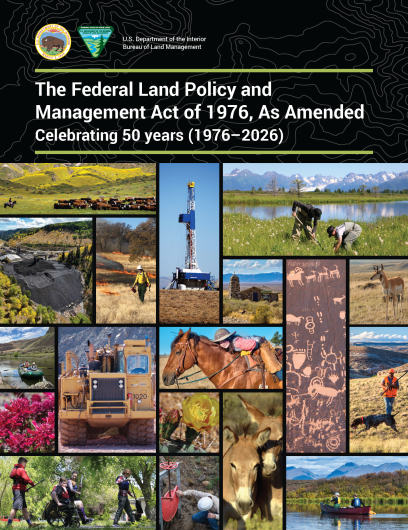
Federal Land Policy and Management Act (FLPMA)
The Federal Land Policy and Management Act—known as FLPMA, pronounced FLIP‑mah—has been the Bureau of Land Management’s central legal authority since it became law in 1976. It establishes the principles and direction for how America’s public lands are managed. Under FLPMA, the BLM must follow a “multiple use and sustained yield” mission, meaning public lands are managed for a balanced mix of uses: not only energy development, grazing, and recreation; but also conservation, wildlife habitat, and cultural preservation. The goal is to ensure these lands remain healthy and productive for generations.
This law also gave the BLM its present-day mission of: "to sustain the health, diversity, and productivity of public lands for the use and enjoyment of present and future generations."
FLPMA requires that BLM decisions rely on scientific data, monitoring, and analysis, and that the agency’s planning and management processes include public participation, transparency, and collaboration. These requirements ensure that land‑use decisions are informed, inclusive, and accountable.