


Whose Land Is It?
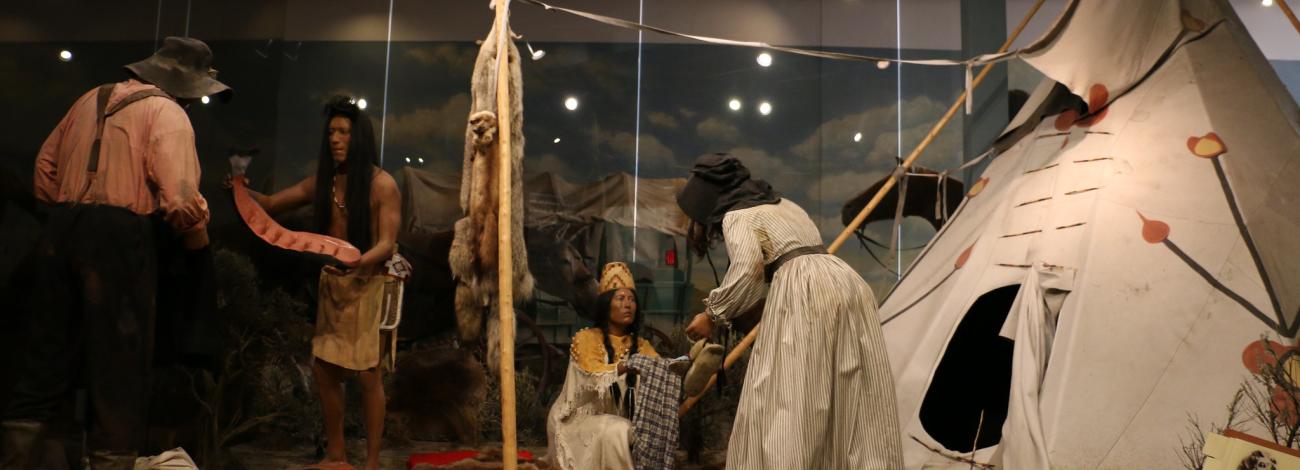
The promise of free land drew hundreds of thousands of Americans to the West. But what does "free" land really mean, and how did pioneers engage with the Indigenous peoples already living on this land? Join us to explore how emigrants and Native Americans thought land in the West should be used, shared, and owned.
Field Trip Length and Grade Range
This two-hour school field trip is designed for students in grades 6, 7 and 8.
How to Participate
Visit School Field Trips for program dates and a registration link.
Whose Land Is It? - Teacher's Guide
Program Objectives
Students will:
- Explore how Native Americans and Oregon Trail emigrants perceived land ownership, and what happened when their different views of land collided.
- Use authentic displays and sources to make inferences about life on the trail.
- Develop empathy and personal connections by imagining the real-life choices faced by the migrants and Indigenous peoples.
- Participate in interactive activities and engage in dialogues, with emphasis on memorable experiences over factual learning.
Vocabulary and Concepts Covered
Doctrine of Discovery: A belief held by many European explorers and settlers that whoever “discovered” land had the right to ownership over the land and the people on it.
Donation Land Claim Act (1850): Encouraged settlement in the Oregon territories by granting free land to white settlers. In denying existing Tribal land claims, this act laid the groundwork for forcing Indigenous Americans out of their homelands and onto reservations.
Indigenous Americans: People who lived in the Americas before European colonization and their descendants. Other common terms include Indigenous Peoples, Native Americans, American Indians, and Tribal Nations.
Manifest Destiny: A belief held by many European explorers and settlers that they had a divine right and duty to expand West across the American continent.
Missionary: A person who travels to spread their religion and try to convert others to their faith. In the 1800s, many Christian missionaries traveled to the Oregon Territory with the goal of converting Native Americans to Christianity.
Primary source: a firsthand account or piece of evidence, made during the time of the event it describes.
Reservation: A specific area of land that set aside by the U.S. government for Indigenous tribes to live on—often through treaties, laws, or executive orders.
Treaty: An agreement signed between countries or parties. Treaties signed between Indigenous tribes and white settlers played a crucial role in defining land ownership and use.
Before the Field Trip
- Assign the Oregon Trail Overview student reading
- Assign or read aloud the Oregon Trail FAQ supplement
- Optional: Assign or read aloud this article about the Donation Land Claims Act of 1850
- Ask the students to reflect on their own ideas about land. There’s no right or wrong answer—just thoughts and experiences.
- What does it mean to “own” land? Imagine someone gives you a piece of land today. Would you let your friends or classmates walk across it, or hunt or grow food there? Would you build a fence around it? Would you share it or keep it private? Why? Now imagine you're an Indigenous American living in the west in the 1800s – how might your answers be different?
- How does your community think about land? Consider the people around you – your neighbors, your town, or your local government. How do they treat land? Do you agree with their ideas about ownership and use? If not, what is a different way of thinking about the land that makes more sense to you?
- Encourage students to think of questions to ask during the field trip.
- Assign students to wagon teams (6 students plus one adult lead per team) that will rotate through stations throughout the exhibit area. Carefully consider social dynamics, including whether to assign students to groups for which their guardian is a chaperone. Number the teams (1, 2, 3...) for easy reference.
During the Field Trip
- Materials needed: None! We will provide leader guides with instructions and answers for the adults, and workbooks for the students.
- Teachers and chaperones are responsible for facilitating activities and discussions at the learning stations. This includes fostering engagement with the material and managing student behavior.
- Example Field Trip schedule:
- 9:30: Arrive, use bathrooms, settle in theater
- 9:35: Theater Introduction
- 9:50: Quick Station Rotations (four stations, 7.5 minutes per station)
- 10:20: Theater Discussion Part 1
- 10:35 Deep Dive Stations
- 11:00 Theater Discussion Part 2
- 11:30 pm: Depart or transition to teacher-led activities
After the Field Trip
- Email us your questions and feedback. We love hearing ways that we can continue to improve our programs!
- Post-activity suggestions:
- Ask students to write an argumentative essay or conduct a debate that builds on the thesis statements and evidence that they developed during the field trip about perceptions of land ownership.
- Students may have identified primary sources that they considered to be missing from the Trail Center. Have students conduct their own research to uncover these sources. How do the new sources impact their perspectives?
- The Donation Land Claim Act of 1850 is just one example of how differing understandings of land ownership became enshrined in law, often to the detriment of Indigenous communities. Ask students to research a treaty or land act from a different time period or region of America. How does this new information add to what you learned during the field trip?
- Throughout the exhibit, students saw a lot of artwork about the land. Paintings like those are important because they can teach us about what people thought at a certain time. But art doesn’t just reflect what people already thought, it can also shape what people will think in the future. Ask students to consider:
- How might you think about land if you grew up seeing paintings like the ones in the exhibit?
- How could you show an Indigenous perspective of land in a painting?
Oregon Social Sciences Standards Addressed
From Oregon Department of Education - Standards - Social Sciences
- 6.3: Examine the origins, purposes, and impact of constitutions, laws, treaties, and international agreements.
- 6:13: Construct and analyze maps, graphs, charts, models, and databases to make inferences and predictions regarding geographic distributions (e.g., perceptual impacts for creating boundaries, borders, cultural regions of indigenous peoples).
- 6.14: Identify and describe how the physical and human characteristics of places and regions connect to human identities and cultures in the Western Hemisphere.
- 6.17: Identify and examine the roles and impact of diverse groups of people (e.g. gender roles, social roles, political and economic structures) within the countries of the Western Hemisphere.
- 6.19: Examine the continuity and change of the indigenous cultures through relevance and contributions to modern society.
- 6.20: Analyze cause and effect relationships within the living histories of ethnic groups, religious groups, and other traditionally marginalized groups in the Western Hemisphere.
- 6.21: Identify issues related to historical events to recognize power, authority, and governance as it relates to systems of oppression and its impact on ethnic and religious groups and other traditionally marginalized groups in the modern era (bias and injustice, discrimination, stereotypes).
- 6.23: Analyze cause and effect relationships within the living histories of indigenous peoples such as land, technology, and competing economic interests.
- 6.28: Construct arguments using claims and evidence from multiple sources, while acknowledging the strengths and limitations of these arguments.
- 7.15: Explain how the physical and human characteristics of places and regions connect to human identities and cultures.
- 7.25: Identify issues related to historical events to recognize power, authority, religion, and governance as it relates to systemic oppression and its impact on indigenous peoples and ethnic and religious groups, and other traditionally marginalized groups in the modern era (bias, injustice, anti-Semitism, discrimination, stereotypes) including individuals who are American Indian/Alaska Native/Native Hawaiian or Americans of African, Asian, Pacific Island, Chicano, Latino, or Middle Eastern descent and traditionally marginalized groups.
- 7.27: Critique and analyze information for point of view, historical context, distortion, propaganda and relevance including sources with conflicting information.
- 7.30: Construct arguments using claims and evidence from multiple sources and diverse media, while acknowledging the strengths and limitations of the arguments.
- 8.3: Compare and contrast how European governments and the United States government interacted with Indigenous peoples.
- 8.20: Identify and describe patterns and networks of economic interdependence, migration, settlement, cultural diffusion, and modern technological development.
- 8.22: Evaluate continuity and change over the course of United States history by analyzing examples of conflict, compromise, cooperation, interdependence, and social justice from multiple perspectives.
- 8.24: Examine the cause and effect of social, political, and economic factors that motivated westward expansion, invasion of indigenous peoples, institutions, and the resulting impacts.
- 8.25: Evaluate the influence of the intersections of identity, including but not limited to, gender, age, race, ethnicity, religion, and class on the experiences of peoples, groups, and events.
- 8.27: Determine and explain the importance and contributions (products, events, actions, and ideas) of key people, cultures, ethnic groups (including individuals who are American Indian/Alaska Native/Native Hawaiian or Americans of African, Asian, Pacific Island, Chicano, Latino, or Middle Eastern descent), religious groups, and other traditionally marginalized groups in Oregon, the United States, and the world.
- 8.28: Identify issues related to historical events to recognize the power, authority, and governance as it relates to systemic oppression and its impact on ethnic and religious groups, as well as other historically persecuted individuals in the United States in the modern era (bias, injustice, discrimination, and stereotypes).
- 8.29: Use and interpret relevant primary and secondary sources pertaining to U.S. History from multiple perspectives.
- 8.30: Synthesize information and data to construct an account of historical events that includes multiple sources and varied perspectives.
- 8.35: Construct explanations using reasoning, correct sequence, examples and details with relevant information and data, while acknowledging the strengths and weaknesses of the explanations