



Red Rock Canyon National Conservation Area
Timed entry reservations are required for the Scenic Drive between October 1 - May 31 for entry between 8 a.m. - 5 p.m. Timed entry reservations can be made at Recreation.gov, or by calling (877) 444-6777.
Red Rock Canyon was designated as Nevada's first National Conservation Area. Red Rock Canyon is located 17 miles (27 km) west of the Las Vegas Strip on Charleston Boulevard/State Route 159. In contrast to a town known for entertainment and gaming, Red Rock Canyon offers outdoor educational and recreational opportunities, including auto touring on the 13-mile (21 km) scenic drive, hikes from a few minutes to a full day, rock climbing, horseback riding, mountain biking, road biking, picnic areas, natural scenery, and a visitor center with exhibits and a book store.
In 1990, special legislation supported by the Nevada congressional delegation changed the status of the Red Rock Recreation Lands to a National Conservation Area, the seventh to be designated nationally and the first in Nevada. This legislation provides the funding to protect and improve the area. Local recreation visitors and visitors from across the United States and the world enjoy Red Rock Canyon Conservation Area every day. More than three million visitors each year enjoy the spectacular desert landscape, climbing and hiking opportunities, and interpretive programs sponsored by the BLM.
The BLM is the largest administrator of public lands in the American West. It adheres to the policy of multiple use, providing recreational opportunities, protection for cultural sites, and management of natural resources, including wildlife.
NEW: From Oct. 1 - Dec. 31, 2026, the BLM is inviting applications for multiple categories of Special Recreation Permits at Red Rock Canyon National Conservation Area. For more information, read the announcement and view the 2026 Permit Opportunity Prospectus.
- Driving Directions
Red Rock Canyon National Conservation Area is only 30 minutes from the Las Vegas Strip. If you are using GPS to navigate, please type in "Red Rock Canyon Visitor Center," or "3205 State Highway 159, Las Vegas, NV 89161."
Public transportation does not extend to Red Rock Canyon. Tour buses and commercial tours may be available from your hotel.
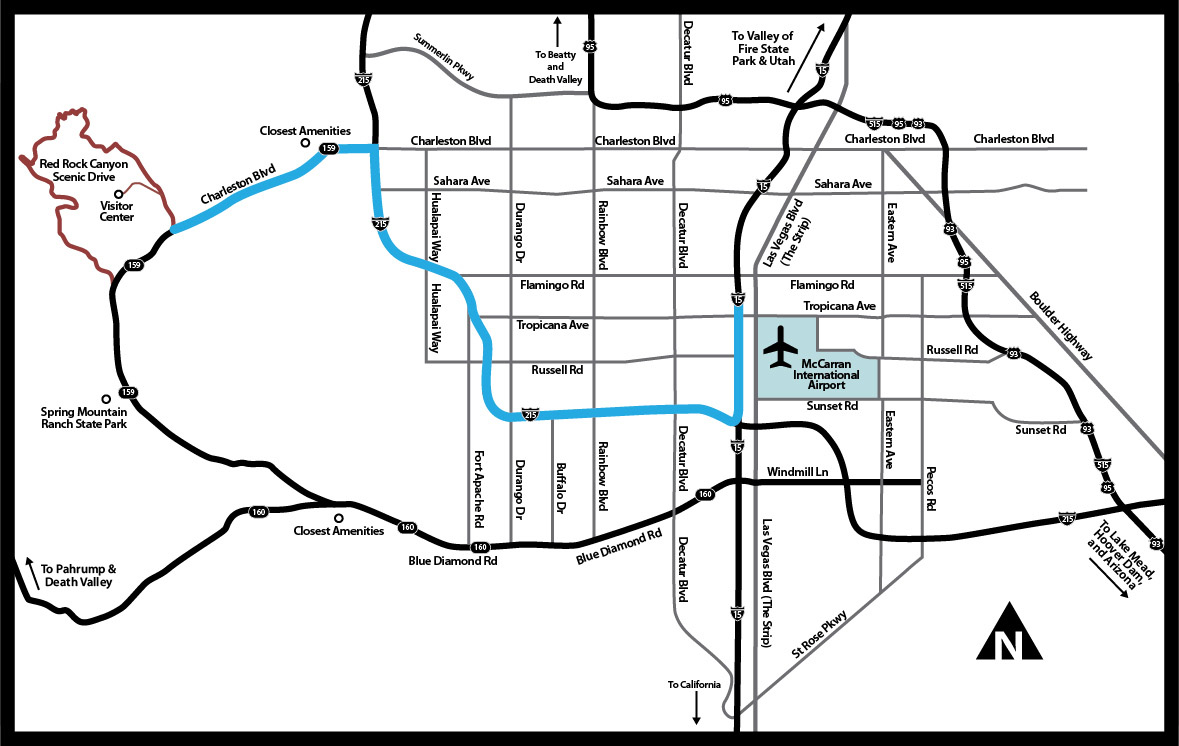
Driving Directions from the Las Vegas Strip south of Russell Road:
- Get on the I-15 south
- Take exit 36 for Russell Road/215 west
- Keep left at the fork, follow signs for Interstate 15 south
- Keep right at the fork, follow signs for 215 west and merge onto 215 west for 13.5 miles
- Take exit 26 for Charleston Boulevard and turn left
- Continue onto State Route 159/ West Charleston Boulevard for 5.5 miles
- Turn right into the Red Rock Canyon Scenic Drive entrance
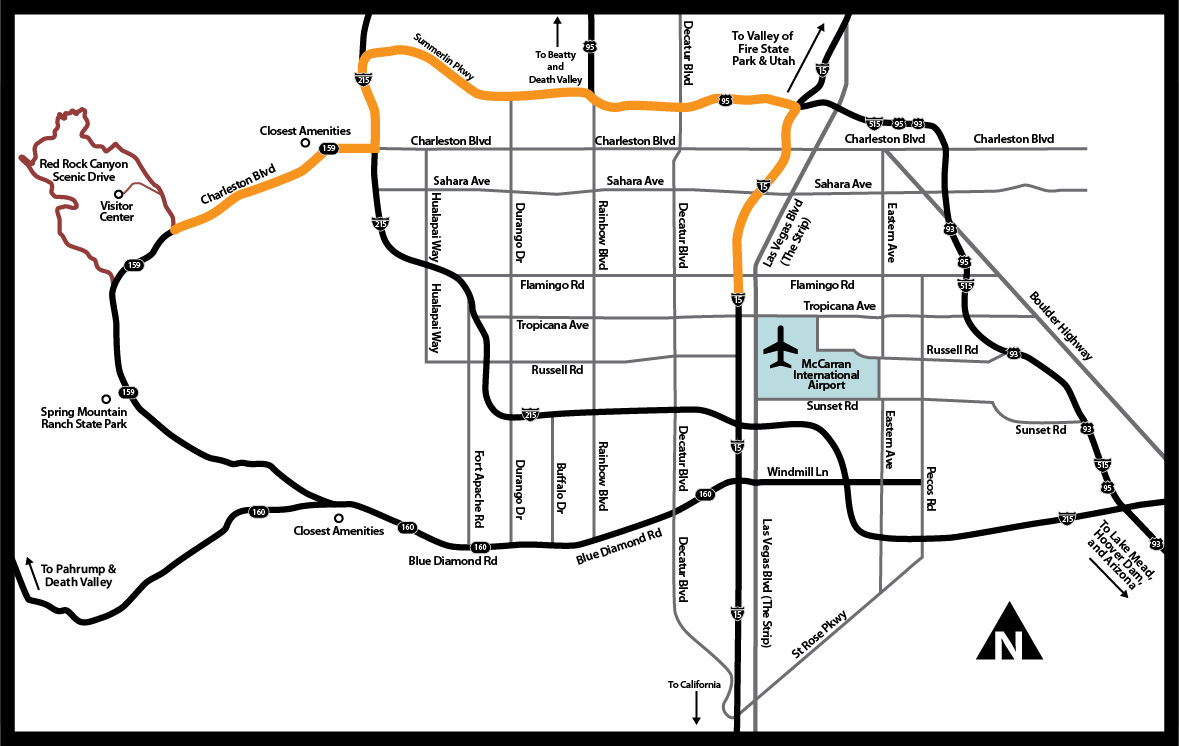
Driving Directions from the Las Vegas Strip north of Russell Road:
- Get on to the I-15 north
- Take exit 42A to merge onto US-95 north toward Reno for 6.8 miles
- Take exit 81A toward Summerlin Parkway and drive west for 6.5 miles
- The freeway will end, exit right to get on to 215 south for 3.5 miles
- Take exit 26 for Charleston Boulevard/State Route 159 for 5.5 miles
- Turn right into the Red Rock Canyon Scenic Drive entrance
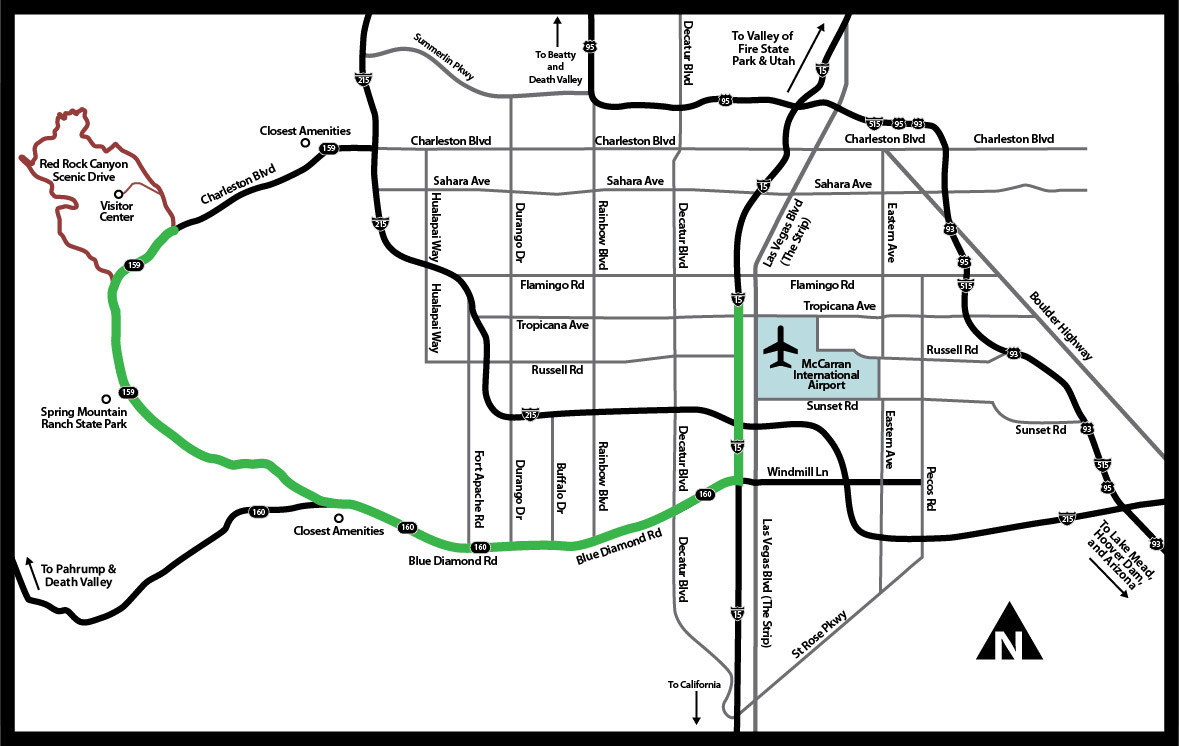
Driving Directions from State Route 160
- Get on to the I-15
- Take exit 33 toward State Route160 west /Blue Diamond Road
- Keep right at the fork and merge onto State Route 160 west /Blue Diamond Road for 10.5 miles
- Turn right onto State Route 159 east/Charleston Boulevard (opposite the gas station) drive for 10.5 miles
- Turn left into the Red Rock Canyon Scenic Drive entrance
- Hours
Red Rock Canyon Scenic Drive
Timed entry reservations are required for the Scenic Drive between October 1 to May 31 for entry between 8 a.m. -5 p.m. Timed entry reservations can be made at Recreation.gov by visiting https://www.recreation.gov/timed-entry/10075177, or by calling (877) 444-6777.
November through February
March
April through September
October6 a.m. to 5 p.m.
6 a.m. to 7 p.m.
6 a.m. to 8 p.m.
6 a.m. to 7 p.m.* The Scenic Drive is open from 6 a.m. to 12 p.m. on Thanksgiving and Christmas Day. *
Commercial busses, motorcoaches, and vans are still required to make timed-entry reservations on Recreation.gov. However, please be aware there will be an additional charge of $5/person (excluding the driver) upon arrival and stops will be limited to the following locations: Visitor Center, Calico I, Willow Spring, and Pine Creek. Groups are allowed to make stops for photos, but are not authorized to hike the trails.
Red Spring Picnic Area
A Recreation.gov reservation is required for group picnics at the Red Spring Picnic Area pavilion. No reservation or entry fee is required for the smaller picnic spots or to hike trails from Red Spring, but parking may be limited.
Timeframe Times November through February
March
April through September
October6 a.m. to 5 p.m.
6 a.m. to 7 p.m.
6 a.m. to 8 p.m.
6 a.m. to 7 p.m.Red Rock Overlook on State Route 159
No reservation or fee is required to stop at the Red Rock Overlook, but parking may be limited.
Timeframe Times November through February
March
April through September
October6 a.m. to 5 p.m.
6 a.m. to 7 p.m.
6 a.m. to 8 p.m.
6 a.m. to 7 p.m.Visitor Center
A timed entry reservation (October 1 to May 31) and entry fee are required to access the Red Rock Canyon Visitor Center.
Days Times Daily
Thanksgiving Day
Christmas Day8 a.m. to 4:30 p.m.
8 a.m. to 12 p.m.
8 a.m. to 12 p.m.Red Rock Canyon Campground
The Red Rock Canyon Campground is available by Recreation.gov reservation only from September 1 to May 31.
The campground is closed from June 1 to August 31, but rugged dispersed camping on the unpaved routes off Lovell Canyon Road (near the community of Mountain Springs) is open year-round while spots are available.
- Accessibility
Red Rock Canyon National Conservation Area and the Bureau of Land Management are dedicated to ensuring everyone has the chance to experience their public lands. Read below to find information on physical, auditory, visual, and neurodiverse accessibility at Red Rock Canyon.
Please note that registered service animals can accompany their owners anywhere within Red Rock Canyon National Conservation Area. Pets as well as companion or emotional support animals are not allowed in the Red Rock Canyon Visitor Center or outdoor exhibits, as these are not recognized as service animals by the Americans with Disabilities Act.
Physical Accessibility
Motorized mobility assistance devices designed for individuals with mobility impairments to explore outdoor areas are permitted on all trails within Red Rock Canyon. However, keep in mind that recreational bicycles and motorized vehicles are only permitted on trails designated for their use.
· Fully Accessible Areas
The following areas are accessible to wheelchairs and strollers and provide excellent opportunities to experience Red Rock Canyon for individuals who cannot walk significant distances, over rough terrain, or up and down steep inclines:
Red Rock Canyon Visitor Center: Accessible parking spaces are available just south of the main walkway to the visitor center (go all the way to the top, past the visitor center, then turn right where first able). One wheelchair is available for temporary use by visitors while at the facility on a first-come first-served basis.
The visitor center hosts indoor and outdoor exhibits (including the tortoise habitat), a gift shop, a short film with closed-captioning, cancellation stamps for Red Rock Canyon National Conservation Area and the Old Spanish National Historic Trail, and panoramic views of Red Rock Canyon. All these features are accessible to wheelchairs, strollers, and individuals with mobility impairment.
While the front of the information desk is not an ADA-compliant height, you may proceed around the information desk to the left to reach an accessible desk. You may also apply for a temporary accessible parking permit at the information desk if you have mobility impairment but no DMV-issued accessible ("handicapped" or "disabled") parking plate or placard.
Scenic Loop Drive: Takes visitors to nine stops, trailheads, or scenic overlooks (not including the visitor center). All except White Rock and North Oak Creek are paved. Calico 1, Sandstone Quarry, High Point Overlook, and Willow Spring Picnic Area have designated accessible parking spaces.
No designated trails along the Scenic Loop Drive are considered accessible to strollers or standard mobility devices. However, a small paved trail at Willow Spring Picnic Area takes visitors to an agave roasting pit and a rock shelter with rock writing. Both have interpretive signage.
Red Spring Picnic Area: Red Spring Picnic Area is accessed via the Calico Basin Road, about five minutes toward Las Vegas from the Red Rock Canyon Visitor Center along State Road 159. Accessible parking spaces are available, and the area hosts several sheltered picnic tables available on a first-come-first-served basis and a large pavilion available by reservation through recreation.gov. No fee or reservation is required to park at Red Spring Picnic Area, but parking is likely to fill up on busy days.
The Red Spring Boardwalk is a 0.6-mile (1.0-km) trail with around 60 ft (15 m) of elevation gain. It is accessible to strollers, wheelchairs, and other standard mobility devices. Several benches are available along the boardwalk, and an intermittent handrail is present for mobility assistance.
Red Rock Overlook: Located along State Road 159, about two minutes toward Las Vegas from the Scenic Loop Drive exit. Accessible parking, scenic views, accessible pit toilets, and scenic views are available. No fee or reservation is required to park at Red Rock Overlook, but parking may fill up on busy days.
Late Night Trailhead: Located on State Road 160, around 15 minutes from the Scenic Loop Drive exit. To get there from the Scenic Loop Drive, take a right on State Road 159 and continue for about 10 minutes. Then, take a right on State Road 160 and continue for about another five minutes. Late Night Trailhead will be on the right. Accessible parking, accessible pit toilets, and scenic views are available at this location. Late Night Trailhead also hosts interpretive signage along a portion of the Old Spanish National Historic Trail and is an excellent spot for accessible night sky viewing. No fee or reservation is required to park at Late Night Trailhead, but parking may fill up on busy days.
· Accessible to Some
The following trails are not accessible to strollers or most standard mobility devices and typically must be traversed on foot. However, they are relatively short and are considered easy, so individuals with some lighter degrees of mobility impairment may be able to enjoy them:
Sundial Trail: This is a 0.1-mile (0.2-km) one-way trail with negligible elevation gain that takes visitors to a sundial with panoramic views and interpretive signage on local wildlife a short distance from the visitor center. Visitors may find a quieter experience here than the viewpoints in the outdoor exhibit space. The trail is mostly paved with a small patch of gravel and hosts one bench at its end.
To get to the Sundial Trail, exit the visitor center and follow the first paved path to the left. When you arrive at a wall, follow the path through the wall and continue to the right. Go past the side-trail that leads to the amphitheater and follow the trail to turn around at the sundial.
Sandstone Quarry: Visitors can access the historic Sandstone Quarry approximately 0.1 mile (0.2 km) from the Sandstone Quarry Parking Lot. Blocks of sandstone showing signs of work, other infrastructure from quarry operations between 1905 and 1912, and interpretive signage are still present at the site. The trail is graded gravel with a slight incline, totaling approximately 30 ft (10 m) of elevation gain on the return trip.
To get to the Sandstone Quarry, take the Scenic Loop Drive and park at the Sandstone Quarry Parking Lot. Follow the gravel path down from the trailhead. Most quarry features are immediately visible at the bottom of the hill.
Petroglyph Wall Trail: An approximately 0.1-mile (0.2-km) one-way trail accessed from Willow Spring Picnic Area. Historic rock writing spanning hundreds or possibly thousands of years of occupation is clearly visible on a panel at the end of the trail, with interpretive signage explaining the site. The trail is rocky and crosses a wash that will likely be impassible after any rain. Total elevation gain is approximately 30 ft (10 m). Rocks range from gravel size to small boulders, so visitors attempting this trail must be able to pick up their feet at least four inches (10 cm) to adequately traverse it. Trekking poles are recommended for individuals who experience balance issues.
To get to the Petroglyph Wall Trail, take the Scenic Loop Drive to Willow Spring Picnic Area. Drive all the way to the last parking area (where the pavement ends and the gravel begins), and you will see the Petroglyph Wall Trailhead on the left as you're coming in. Be sure to note where the trail continues on the other side before you enter the gravely wash.
Auditory Accessibility
The visitor center has a short film with ADA-compliant closed captioning. Printed informational sheets and brochures are available at the information desk, and most interpretive signage in and around the visitor center relies on written language.
Visual Accessibility
Visually impaired individuals who use canes should be aware that the visitor center floor has cracks approximately 0.25 in (0.6 cm) wide that may interfere with their ability to navigate. Visitors may touch bronze statues of animals and plants native to Red Rock Canyon in the outdoor exhibit space at the visitor center.
Neurodiverse Accessibility
Red Rock Canyon National Conservation Area welcomes individuals of all parts of the neurodiverse spectra. Individuals seeking tactile objects may feel the bronze statues of animals and plants native to Red Rock Canyon in the outdoor exhibit space, and individuals are welcome to feel plantlife and rocks within the conservation area. However, please be aware that some plants may have irritating chemicals or surfaces, others may be incredibly delicate, and cactuses and yuccas have potential to cause injuries, so please research the plants you may wish to touch before engaging in tactile connection to the environment. You are ultimately responsible if you are injured or if you damage plantlife at Red Rock Canyon.
Visitors should be aware that the visitor center (including outdoor exhibits) and even certain trails and remote areas like the Sandstone Quarry and Calico Tanks Trail, the Calico 1 Parking Area, the High Point Overlook, the Red Spring Picnic Area and Boardwalk, and the Willow Spring Picnic Area and associated trails can be loud and potentially overstimulating on busy days. Visitors seeking a quiet environment to decompress should seek out more remote environments, such as lengthier less visited trails. Some nice places to find quiet solitude in Red Rock Canyon include the Red Rock Wash Overlook, the Pine Creek Canyon (moderate) and Fire Ecology (easy) Trails, and the Late Night Trailhead off State Route 160.
- Photography
Red Rock Canyon National Conservation Area’s scenic vistas inspire many amateur and professional photographers.
Most visitors take snapshots of their visit. This is considered casual use and does not require a film permit. It is typified by an individual or group of individuals taking pictures, either still or moving, for personal use.
In some cases, permits may be required.
Still photography requires a film permit when one or more of the following situations apply:
- Use of models or props which are not part of a site’s natural or cultural resources or administrative facilities are involved.
- Family or wedding portraits taken by professional photographers would be considered use of “models” as would products placed at the site. Props include reflectors, bounce cards, sound booms, or similar equipment.
- If such photography takes place at locations where members of the public are generally not allowed.
- If it occurs where additional administrative costs are likely.
Commercial still photography like photographs of scenery or wildlife, for magazine articles, advertisements, books, calendars, postcards, etc., does not require a film permit if none of the above criteria apply. This includes photographs that may have products or models superimposed on them later.
Moving photography (filming) requires a film permit when documentaries, television programs, feature films; advertisements, wildlife filming, or similar projects if none of the above criteria apply.
Film and/or photography permits need to be acquired in advance. Processing time can take up to 60 days. Other restrictions may apply.
Student filming projects do not require a filming permit as long as the activity would not adversely impact public lands. Students need to submit a proposal in writing, with verification from the educational institution that it is a required project.
Film/Photography permits need to be acquired in advance. For more information, please email BLM_NV_Film_BLMSouthernNevada@blm.gov or call (702) 515-5381.
- Special Recreation Permits
Special Recreation Permits (SRPs) are permits issued for use of BLM lands by commercial interests, organized groups, and certain uses.
Common things that need a permit are: Weddings, guiding for pay, large groups, rock climbing groups and instruction, exclusive use of an area, special events, food service and vending and big meetup groups.
Since Red Rock Canyon is a National Conservation Area there are use and permit limits to protect the natural resources and cultural sites within. Uses must follow laws and regulations, such as the National Environmental Policy Act and Resource Management Plan (2005).
When do I need a Special Recreation Permit? 43 CFR 2932.11
You must obtain a Special Recreation Permit for:- Commercial use, including vending associated with recreational use; or
- Competitive use.
- If BLM determines that it is necessary, based on planning decisions, resource concerns, potential user conflicts, or public health and safety, we may require you to obtain a Special Recreation Permit for—
- Recreational use of special areas;
- Noncommercial, noncompetitive, organized group activities or events; or
- Academic, educational, scientific, or research uses
In some cases an SRP may not be necessary – but an Outdoor Recreation Planner can help determine that.
How do I apply?
It is highly recommended you call or email us to discuss your needs so we can best help you. SRPs can be applied for through email, the online portal RAPTOR, and if needed, physical mail or in person.The application can be found here: https://www.blm.gov/sites/default/files/docs/2023-08/2930-1.pdf
For weddings, please email blm_nv_sndo_rrc_recreation@blm.gov for more information.
Permit Limits for Common Guided Activities Common Guided Activity Permit Limit Climbing 5 full-time* Hiking 5 full-time Four-wheel Drive Tours 4 full-time Equestrian - Horseback 2 full-time Biking (road and mountain biking) 4 full-time Yoga, Art, and Photography 5 full-time Weddings - commercial 10 full-time* Weddings - noncommercial 100 permits Guest Climbing*
10 days per year8 commercial
4 educational - schoolRunning, biking and other race events 5 permits each (approximate) *These permit allotments are currently full.
**Guest Climbing is conducted through a yearly lottery.If your event does not fit one of these categories, please contact us to discuss!
Required Paperwork and Information
It is the responsibility of the permit holder to comply with all laws, regulations, and requirements of other entities such as State, county, or other federal agencies.- Application: A completed and signed 2930-1
- Insurance: Valid insurance with the “United States of America” as additionally insured. Minimum requirements are property damage $30,000; Per occurrence $300,000; Aggregate $600,000.
- Operations Plan: A detailed operations plan with a safety and communications plan is required.
- Fees: The minimum fee of $130 is required before use or event. Other fees apply:
- 3% gross receipts or $7 per person, depending on the activity.
- $260 assigned site fees, if applicable.
- Cost recovery, if requiring more than 50 hours of staff time.
Full-Time Permit Prospectus and Application Period
As of summer 2025, Red Rock Canyon NCA anticipates releasing a prospectus and application period for new, full-time permits within the year. During this time we will invite and asses applications for multiple full-time permit spaces such as hiking, biking, and yoga. Please contact us for more information on this process.Contact
If you have additional questions or would like to discuss your needs, please email or call us.
Email: blm_nv_sndo_rrc_recreation@blm.gov
Phone: 702-515-5371- Visitor Center
A favorite stop is the visitor center. The Red Rock Canyon Visitor Center is a one-stop shop for getting tips on how to make the most of your visits. It’s a great place to learn more about Red Rock Canyon National Conservation Area and the Mojave Desert and to pick up a few souvenirs.
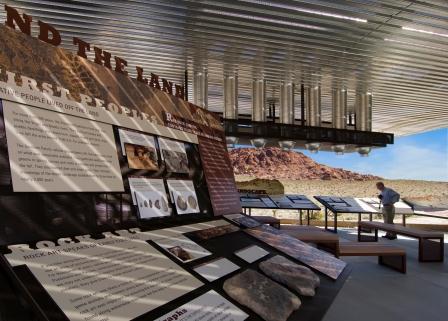 The LEED gold-certified visitor center is designed to encourage stewardship for public land by providing an outdoor experience that instills a sense of personal responsibility.
The majority of the innovative interpretive exhibits are outside with four themed elements: earth, air, fire, and water. If you are eager to see desert tortoises or to learn more about Red Rock Canyon's geology, head toward the earth exhibit. The air exhibit illustrates the importance of the atmosphere and the night sky to the Mojave Desert's wildlife and people. If you think this area is roasting hot in the summer, check out the fire exhibit to learn about important cultural sites called agave roasting pits. Though it may not come to mind when you think of the desert, the water exhibit will remind you how precious this resource is.
The indoor portion of the visitor center includes a reception desk staffed by helpful employees and volunteers, a million-dollar view of the Calico Hills from a drafting table open for visitors to use, some exhibits, a community corner with rotating activities, a 17-minute film about Red Rock Canyon, and a gift shop.
When the original visitor center – now the administrative building – opened in 1982, about 20,000 people visited Red Rock each year. Now, around three million people a year visit the area. To address this issue, the Secretary of the Interior approved funds under the Southern Nevada Public Land Management Act to build a new visitor center -- opened in 2009 -- to provide enhanced visitor services to the increasing number of people who visit the National Conservation Area each year.
- For Teachers and Parents
Teacher Resources - This link provides teachers with information and resources about Red Rock Canyon the surrounding area and general teaching aids.
- Become a Junior Ranger
You can explore, protect, and learn about the outdoors by becoming a Junior Ranger at Red Rock Canyon National Conservation Area. Whether you’re visiting in person or starting your adventure from home, the program is easy and fun.
While Visiting Red Rock Canyon National Conservation Area
Stop by the Red Rock Canyon Visitor Center to pick up a Red Rock Canyon Junior Ranger activity book. These books are filled with hands-on, place-based activities that help kids (and adults) discover the geology, wildlife, and history of the canyon. Activities are designed to be completed during your visit, but you can also complete the book at home.
Start Your Adventure from Home
Download the Junior Ranger activity book:
Complete the required number of pages for your age group. When you’re finished, you can:
Bring your completed book to the Red Rock Canyon Visitor Center
Scan and email your pages to BLM_NV_RRC_RangerPrograms@blm.gov
Mail your completed book to:
Junior Ranger Program
1000 Scenic Loop Drive
Las Vegas, NV 89161
Be sure to include your name and mailing address so a ranger can send you your official Junior Ranger badge!
- Volunteer
Volunteering is an American tradition that has made immeasurable contributions to communities, organizations, and individuals throughout the country.
Your contribution of time and energy will help us protect the magnificent natural and cultural areas entrusted to the American people, and you’ll go home with a sense of pride at having participated in something worthwhile.
Red Rock Canyon National Conservation Area is public land: yours to care for and to cherish.
Individuals, families, and organized groups are welcome to volunteer. Opportunities are available for beginners to highly skilled professionals and for short term and long-term commitments. Volunteering at Red Rock Canyon can be challenging but is always rewarding.
What are the benefits?
- You get to meet new people with the same interests.
- You get to learn about the desert environment so close to the city that we live.
- Free training on subjects such as geology, plant, animals, and native peoples.
- Best of all you get to play outside.
- BLM volunteers have the same benefits as federal government employees for compensation for work-related injuries and tort claims protection. Although volunteers contribute their services without pay, they may deduct out-of-pocket expenses on income tax returns within the limits set by tax laws. Deductions can include car mileage, meals and lodging expenses incurred as a result of volunteer work.
The only areas which prohibit volunteers are law enforcement, fire suppression, and participating on special use flights.
A few volunteer opportunity examples are:
- Visitor Center Information Desk
- Red Rock Canyon Loop Ambassador
- Tortoise Habitat
- Hummingbird Feeding
- Canyon Cleanup
- Trail Maintenance
- Trail Monitoring
- Native Plants and Invasive Species
- Dedication Walkway Care
If you have an interest in volunteering your time and expertise to Red Rock Canyon, please contact Friends of Red Rock Canyon (https://www.friendsredrock.org/volunteer) or the Bureau of Land Management Volunteer Coordinator at 702-515-5313.
- Partnerships
Enjoying Red Rock Canyon National Conservation Area? We are fortunate to have agreements with these partner organizations that helped make your visit possible:
 The mission of the Southern Nevada Conservancy (SNC) is “to enhance the recreational, educational and interpretive programs of the Bureau of Land Management, and other governmental agencies, by providing materials and services to the public which promote an understanding and appreciation of the natural history, cultural history and sciences of Southern Nevada and specifically, Red Rock Canyon National Conservation Area.” Interpretation and education, sales, fee station staffing, and professional and financial support let the SNC fulfil this mission.
Interpretation and Education
- Guided Hikes and Programs: SNC interpretive staff work with BLM staff to present programs to school groups and to the public. Though SNC staff always lend a helping hand with visiting school programs, they offer a variety of activities to our visitors. These include guided hikes, tabletop presentations, and programs on astronomy, geology, wildlife, and cultural history. Classes such as sketching and jewelry making round out their contribution.
- Off-Site Education: Special programs are available to schools and community organizations. Programs are available for other groups, including senior living centers and at-risk youth.
- Professional and Financial Support: SNC provides support in many ways, including the design and purchase of interpretive signs, planning costs, trail creation and other projects.
Elements Gift Shop
All net proceeds from purchases at the Elements gift shop support a wide variety of programs and activities at Red Rock Canyon. Items offered include books, souvenirs, gifts and creations from local artists.
The mission for Friends of Red Rock Canyon (Friends) is to promote the preservation and enhancement of Red Rock Canyon National Conservation Area through volunteerism, philanthropy and education. Friends provides both financial and administrative support and over 350 dedicated volunteers to preserve and enhance Red Rock Canyon NCA.
Friends funds and helps organize the daily volunteer activities that keep Red Rock Canyon the gem that it is. Its members donate approximately 10,000 hours each year to clean up graffiti, conduct trash pickups and trail maintenance, maintain the visitor center grounds, staff the information desk, monitor cultural sites, care for our tortoise habitat and its inhabitants, host community volunteer events, provide native plant rehabilitation, among other activities.
Friends also collaborates with the BLM to develop and deliver programs and events to educate visitors and enhance the visitor experience at RRCNA. These include funding and administering bus transportation for local school field trips, the Artist-in-Residence program and the BARK Ranger program.
You can support Friends of Red Rock Canyon’s efforts by:
- Becoming a member. Support Friends efforts financially and join a community who loves Red Rock Canyon.
- Purchasing a Dedication Walkway tile. Sandstone tiles can be personalized to honor a loved one in the Visitor Center picnic area.
- Obtaining a Red Rock Canyon NCA license plate. Friends receives yearly tax-deductible donations from the sales and renewals of a Nevada Department of Motor Vehicles license plate depicting Red Rock Canyon.
- Donating funds – for a specific project or to be used in the area of greatest need.
- Contact Numbers
Mailing Address
Red Rock Canyon National Conservation Area
1000 Scenic Loop
Las Vegas, NV 89161-1202Emergency, Law Enforcement, or Fire
702-293-8932 or 911Red Rock Canyon Main Information Line
702-515-5350Gift Shop and Bookstore
702-515-5379Reservations for Scenic Drive Timed Entry, Campsites, and Group Picnic Area
877-444-6777Commercial, Weddings, Large Groups Competitive Events, and Vending Permits
702-515-5371Film and Photography Permits
702-515-5399/5381Volunteer Coordinator
702-515-5313Friends of Red Rock Canyon
702-515-5360Southern Nevada Conservancy
702-515-5367BLM Southern Nevada District Office
702-515-5000